99% of Jewish Organizations Worldwide are Zionist
An analysis of the hegemonic dominance of Zionism among Jewish organizations and institutions worldwide

NOTE: This is an excerpt from a longer article:
The support for Israel among Jews worldwide stretches from individuals to community organizations, events, synagogues and larger institutions.
Analysis of Jewish organizations worldwide
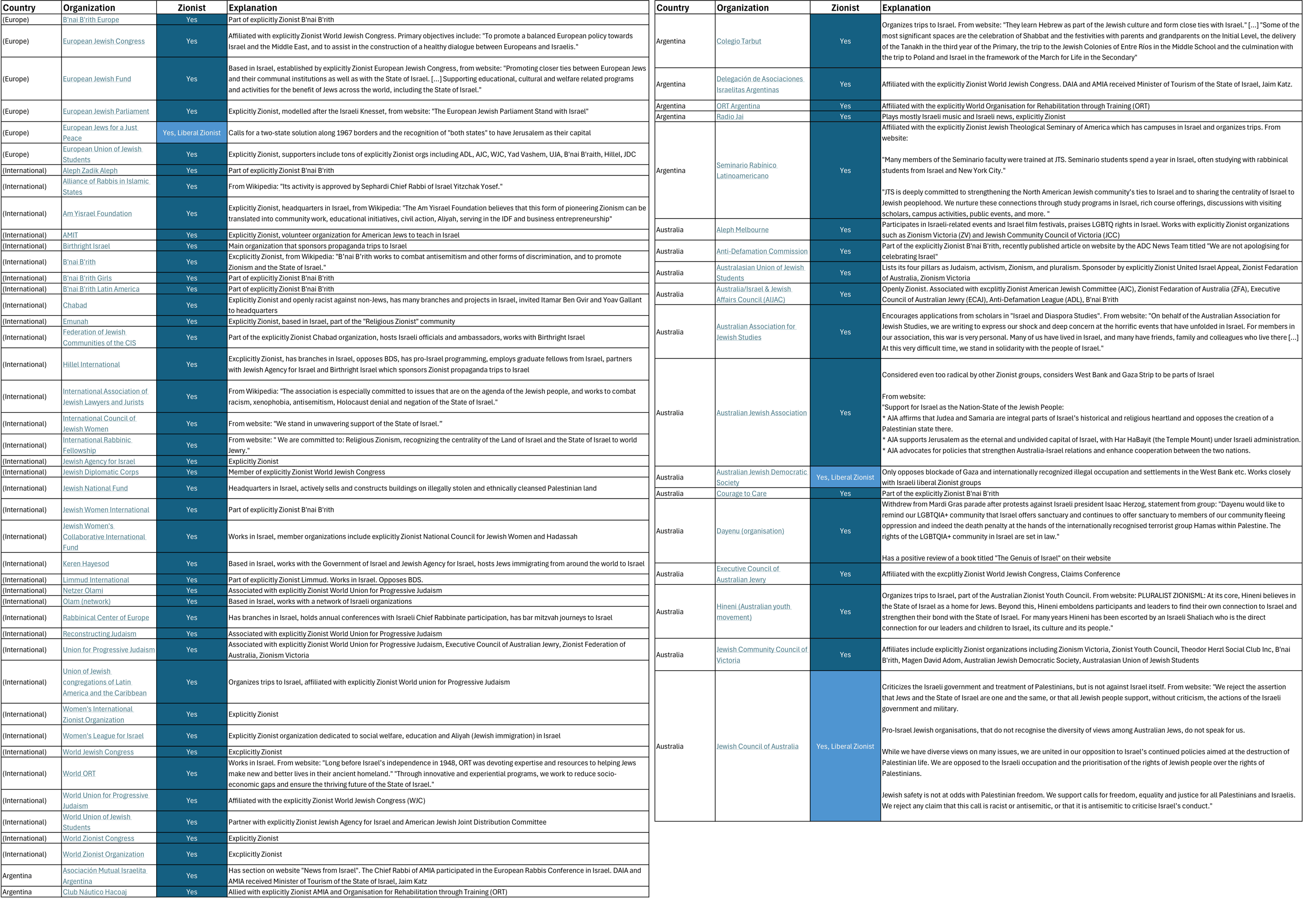
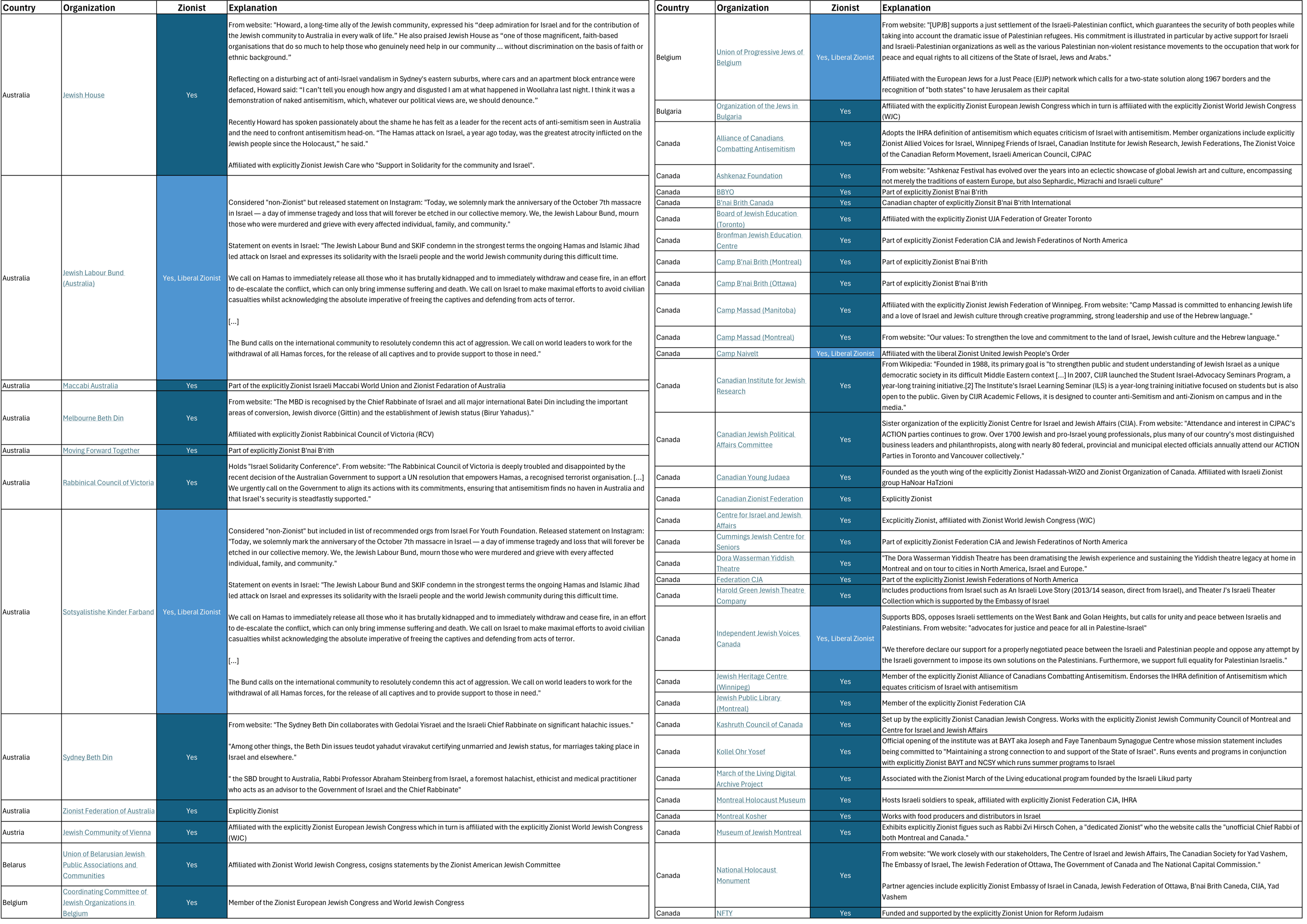
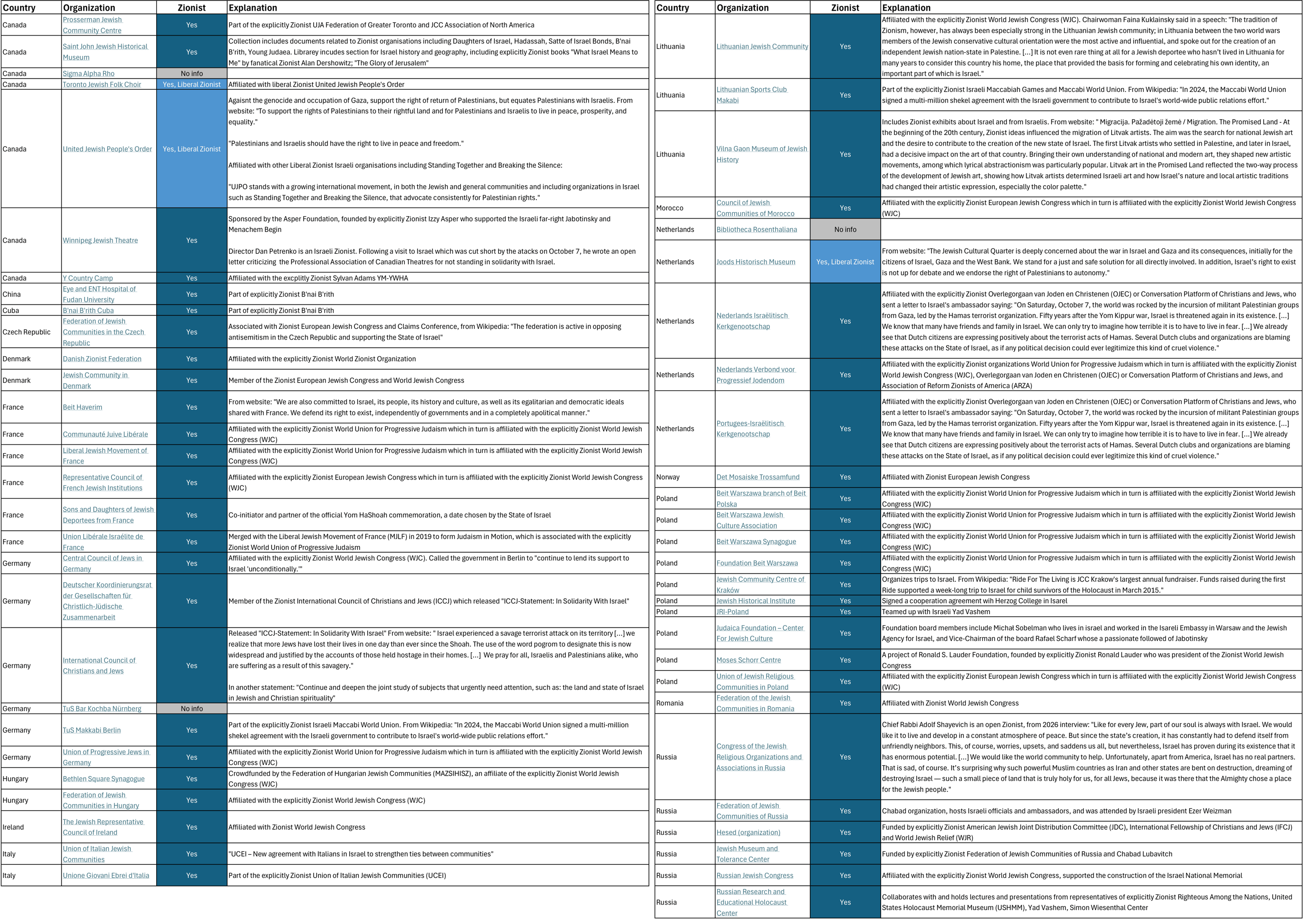
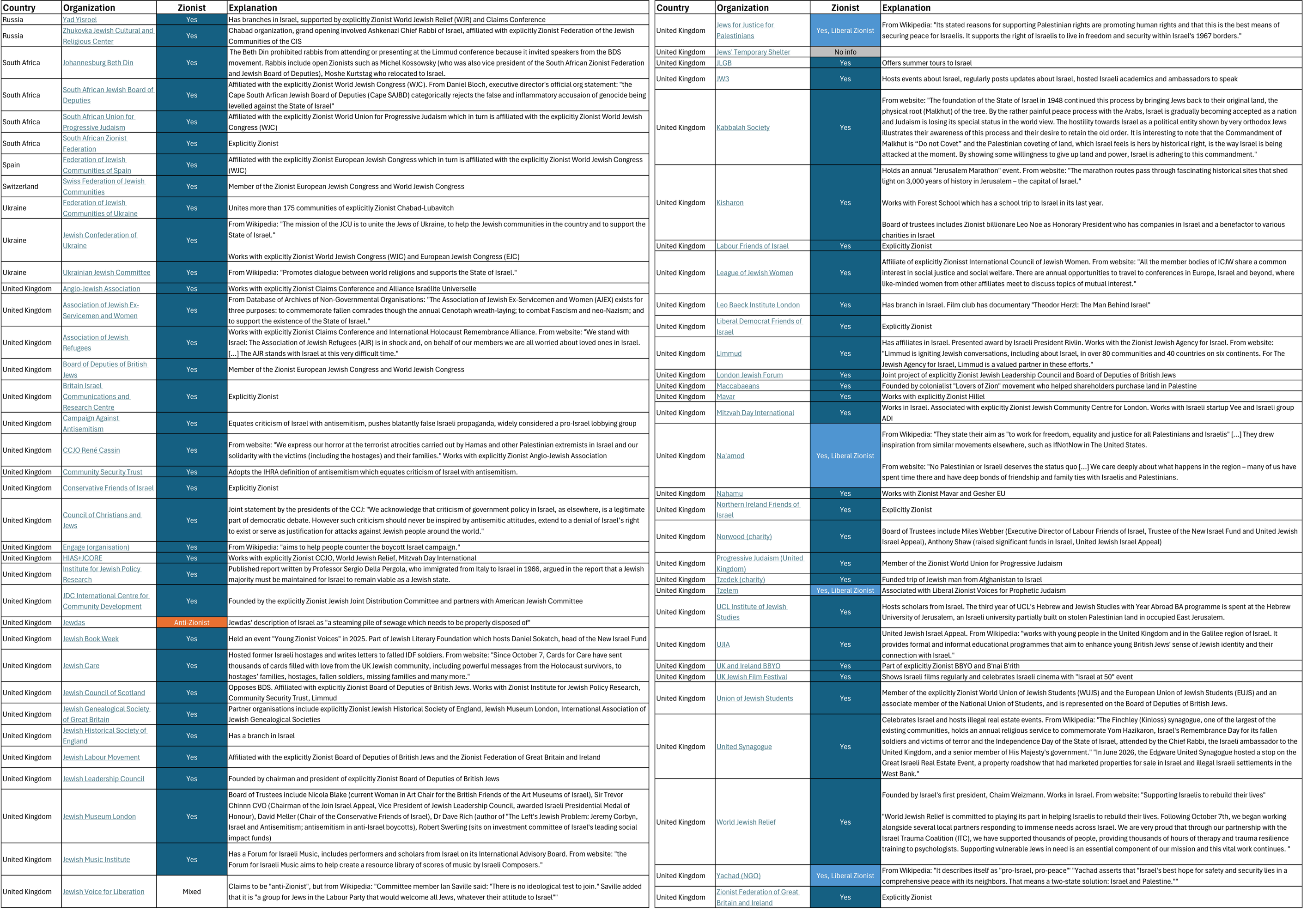
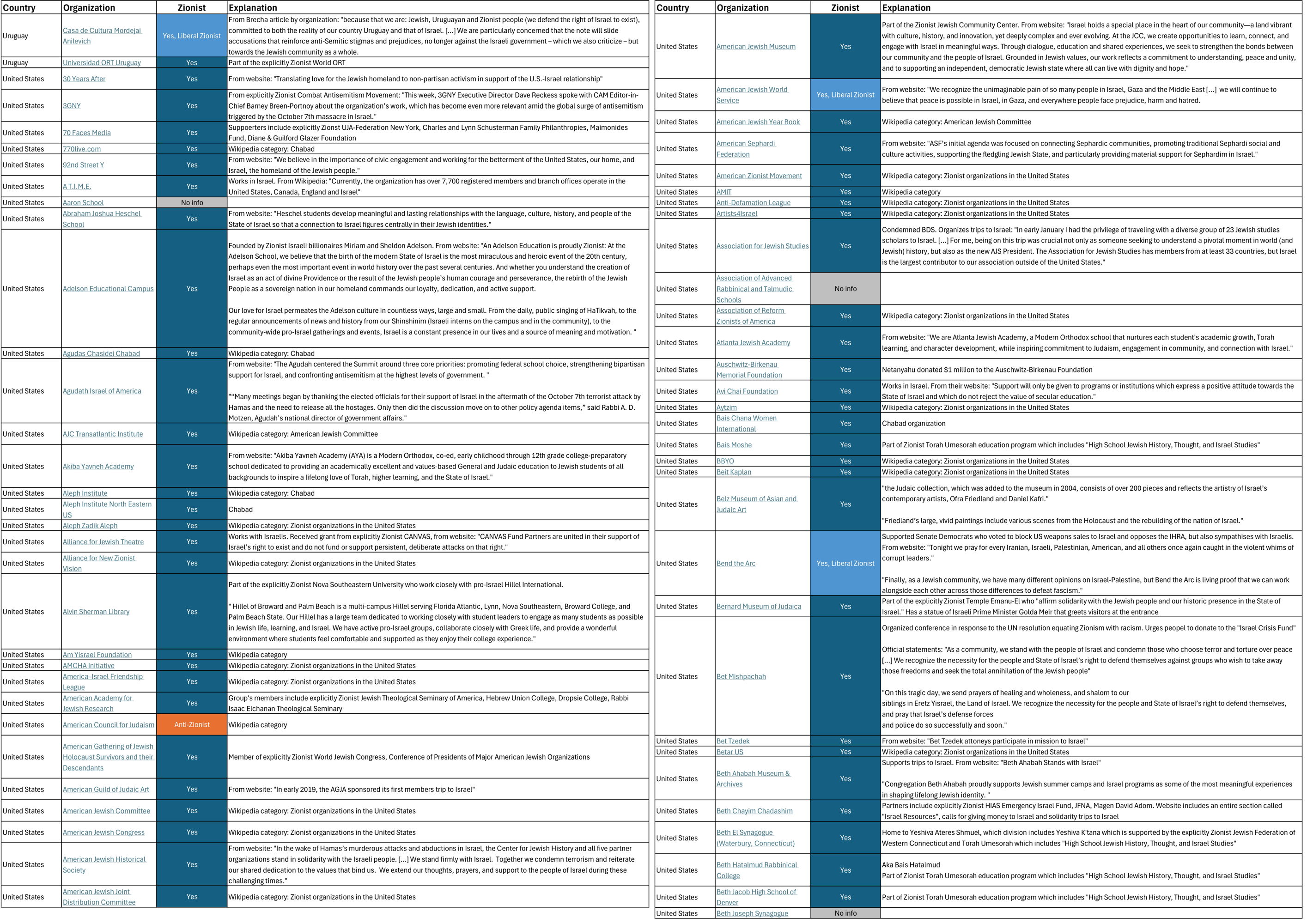
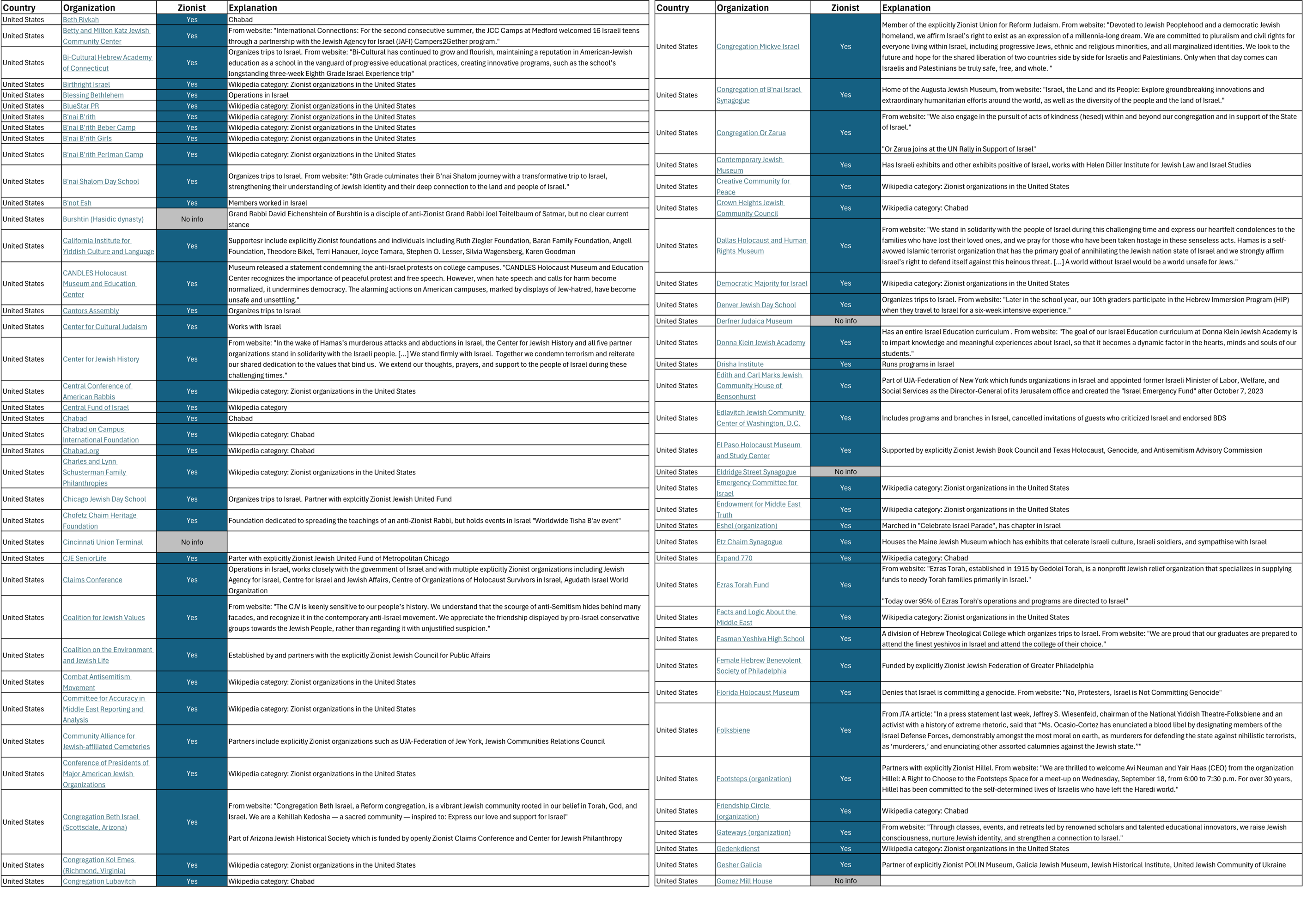
For a rough estimate of how dominant Zionism is among Jewish organizations, I carried out an analysis of the Wikipedia category page for ‘Jewish organizations by country.’ As of May 2026, the page lists approximately 719 organizations across 30 countries (excluding Israel) in this category and its sub-categories including community organizations, history organizations, museums, charities, LGBTQ groups, etc. It should be noted that not every organization is explicitly marked as pro-Israel on Wikipedia, so a deeper analysis required reviewing each one individually. For each organization, I assessed whether it qualifies as Zionist based on the following criteria:
Explicitly states support for Israel on its website or other public platforms
Leaders or key members publicly express pro-Israel positions
Affiliated with other known pro-Israel organizations
Operates branches or programs within Israel
Includes pro-Israel studies or Zionist education in its curriculum
Has released public statements sympathetic to Israel
Listed in other Wikipedia Zionist categories or sub-categories such as Zionism by country, Zionist by continent, Chabad, etc.
Note: For relevance and brevity, I excluded the following categories from analysis: defunct Jewish organizations, Jewish-American organized crime groups, Synagogues in the United States, and Jewish day schools in the United States.
Out of the 719 organizations investigated, 686 had sufficient publicly available information to determine their stance on Zionism/Israel. Of those 686, 681 organizations (99%) can be classified as Zionist. This includes Liberal Zionist organizations that may make token references to Palestinians or two-state solutions; even excluding those, the proportion remains at approximately 90% of all organizations with clear stances. To put it another way: only 3 or 4 organizations out of 719 with sufficient information could be classified as non-Zionist or critical of Israel. The remaining 33 organizations had no stated stance, insufficient information available, or no discernible relationship to pro-Israel groups. Including organizations with unknown stances, the minimum proportion of Zionist organizations among all 719 is 95% (681/719).
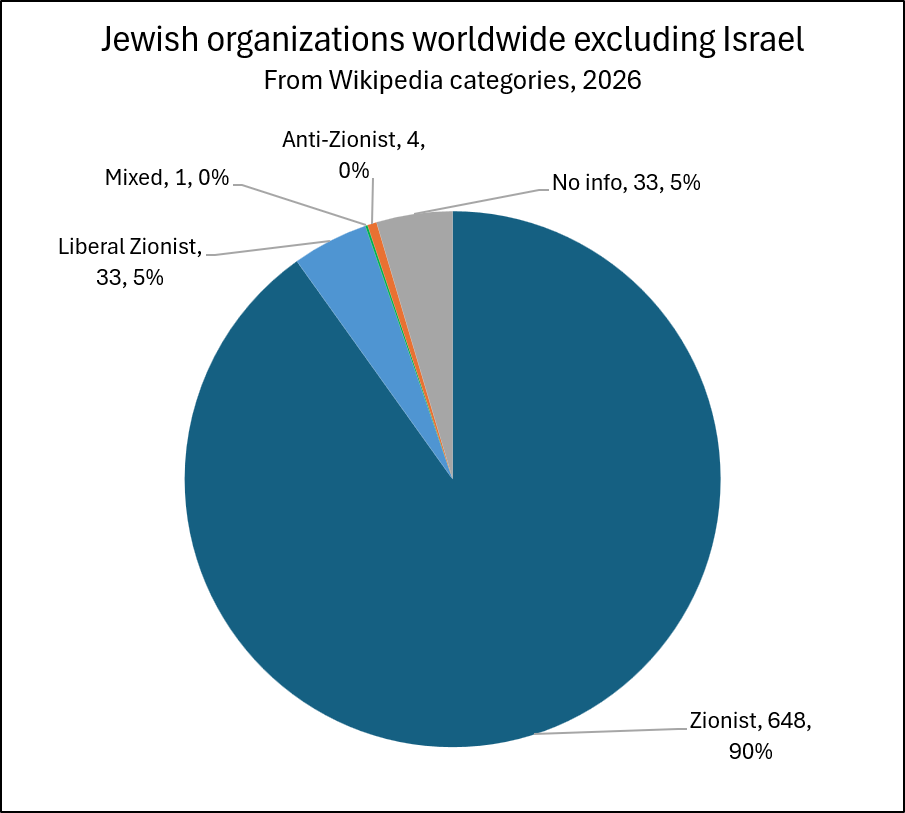
Below is a breakdown showing how many organizations are Zionist out of the total in each country, including organizations with no discernible info:
International organizations: 100% (36/36)
European organizations (not specific to one country): 100% (6/6)
Europe: 96% (116/121)
United Kingdom: 96% (53/56)
Poland: 100% (10/10)
Russia: 100% (8/8)
France: 100% (6/6)
Germany: 100% (5/5)
Netherlands: 100% (4/4)
Lithuania: 100% (3/3)
Ukraine: 100% (3/3)
Denmark: 100% (2/2)
Hungary: 100% (2/2)
Italy: 100% (2/2)
Austria: 100% (1/1)
Belarus: 100% (1/1)
Belgium: 100% (1/1)
Bulgaria: 100% (1/1)
Czech Republic: 100% (1/1)
Ireland: 100% (1/1)
Norway: 100% (1/1)
Romania: 100% (1/1)
Spain: 100% (1/1)
Switzerland: 100% (1/1)
North America
United States: 93% (455/487)
Canada: 99% (37/38)
Latin America
Argentina: 100% (7/7)
Cuba: 100% (1/1)
Uruguay: 100% (1/1)
Asia / Oceania
Australia: 100% (22/22)
China: 100% (1/1)
Africa
South Africa: 100% (4/4)
Morocco: 100% (1/1)
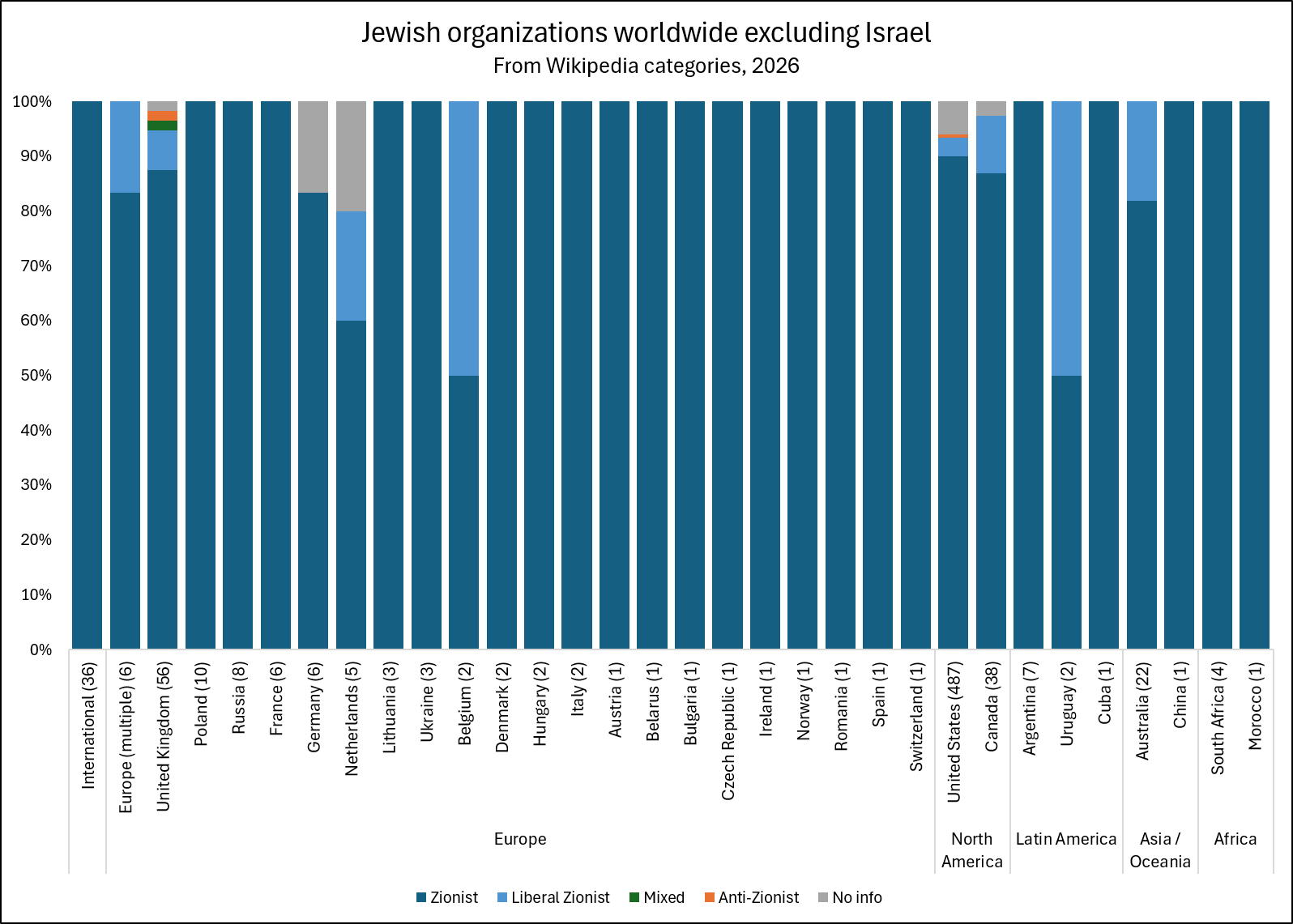
This analysis is by no means a thorough or perfect academic survey. Nevertheless, the magnitude of Zionism within Jewish organizational life—upwards of 90%—by any reasonable measure is unmistakable.
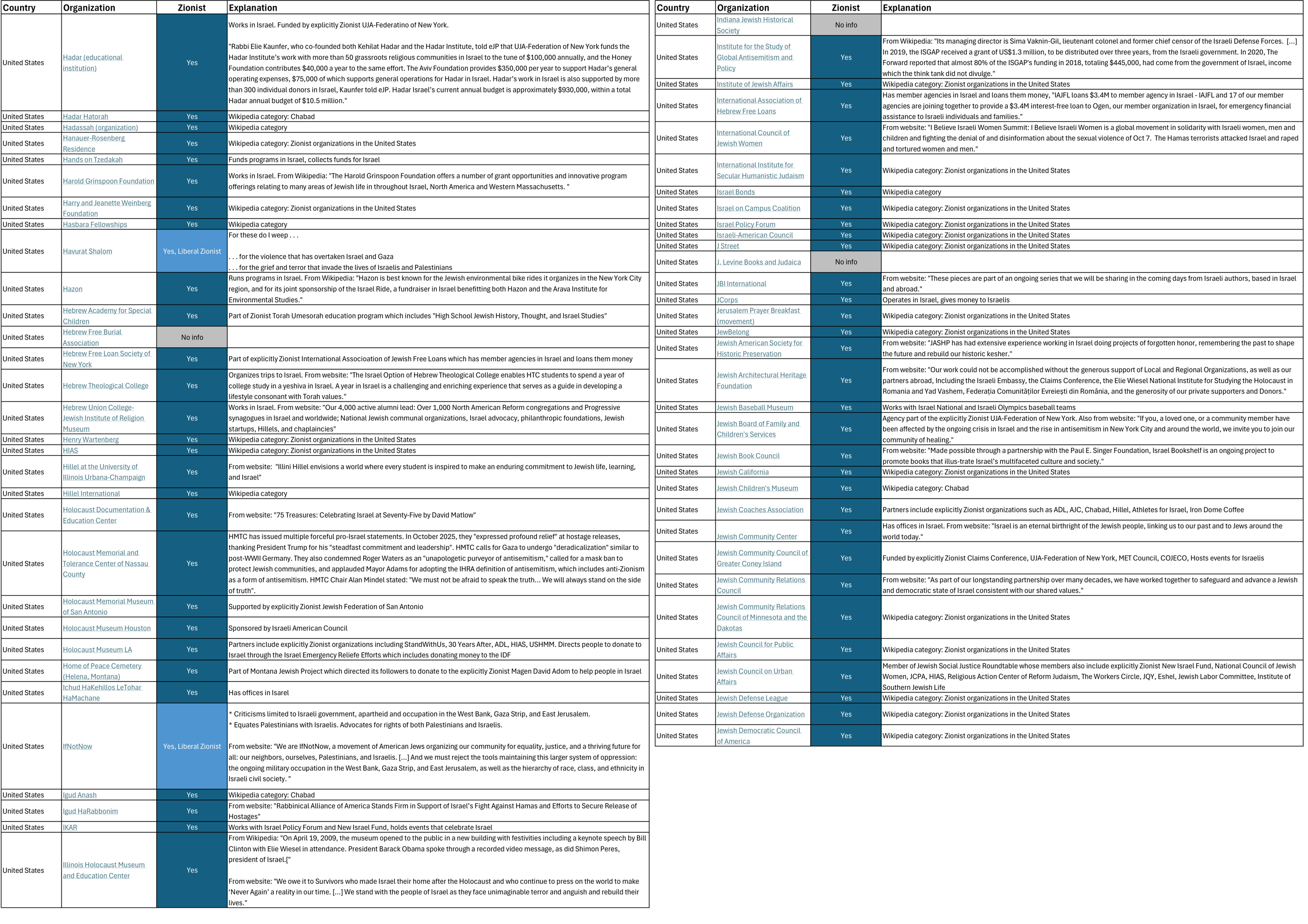
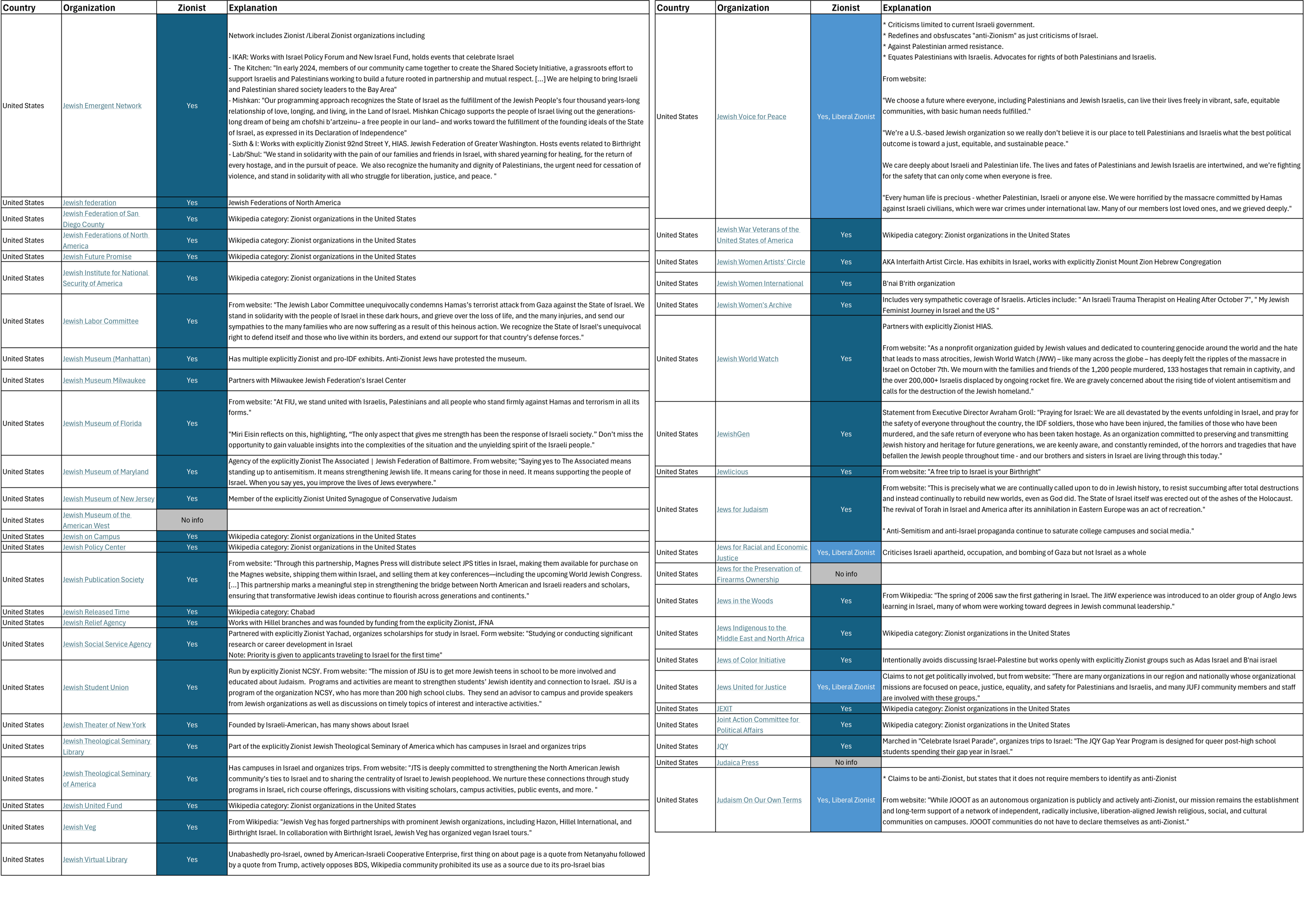
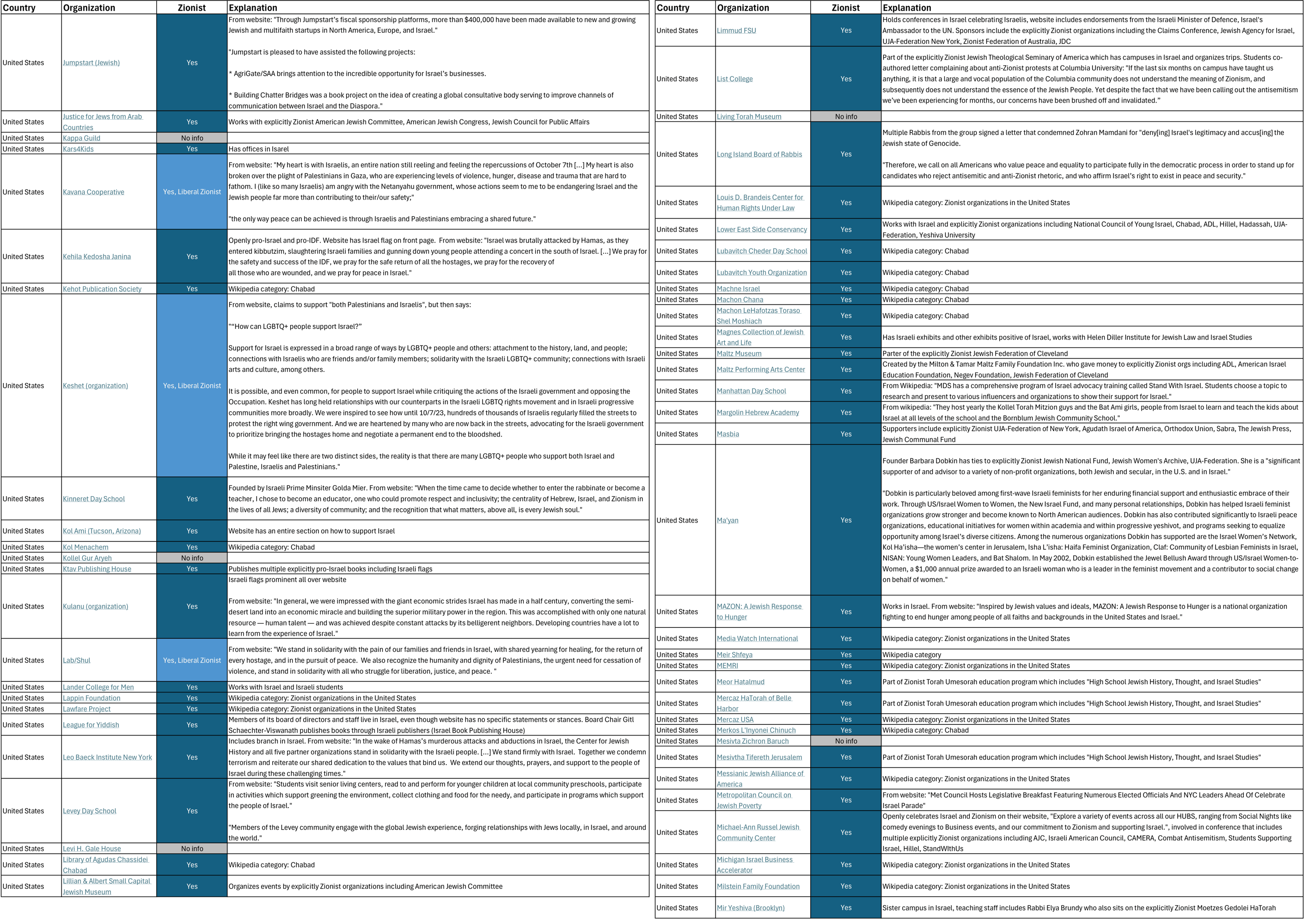
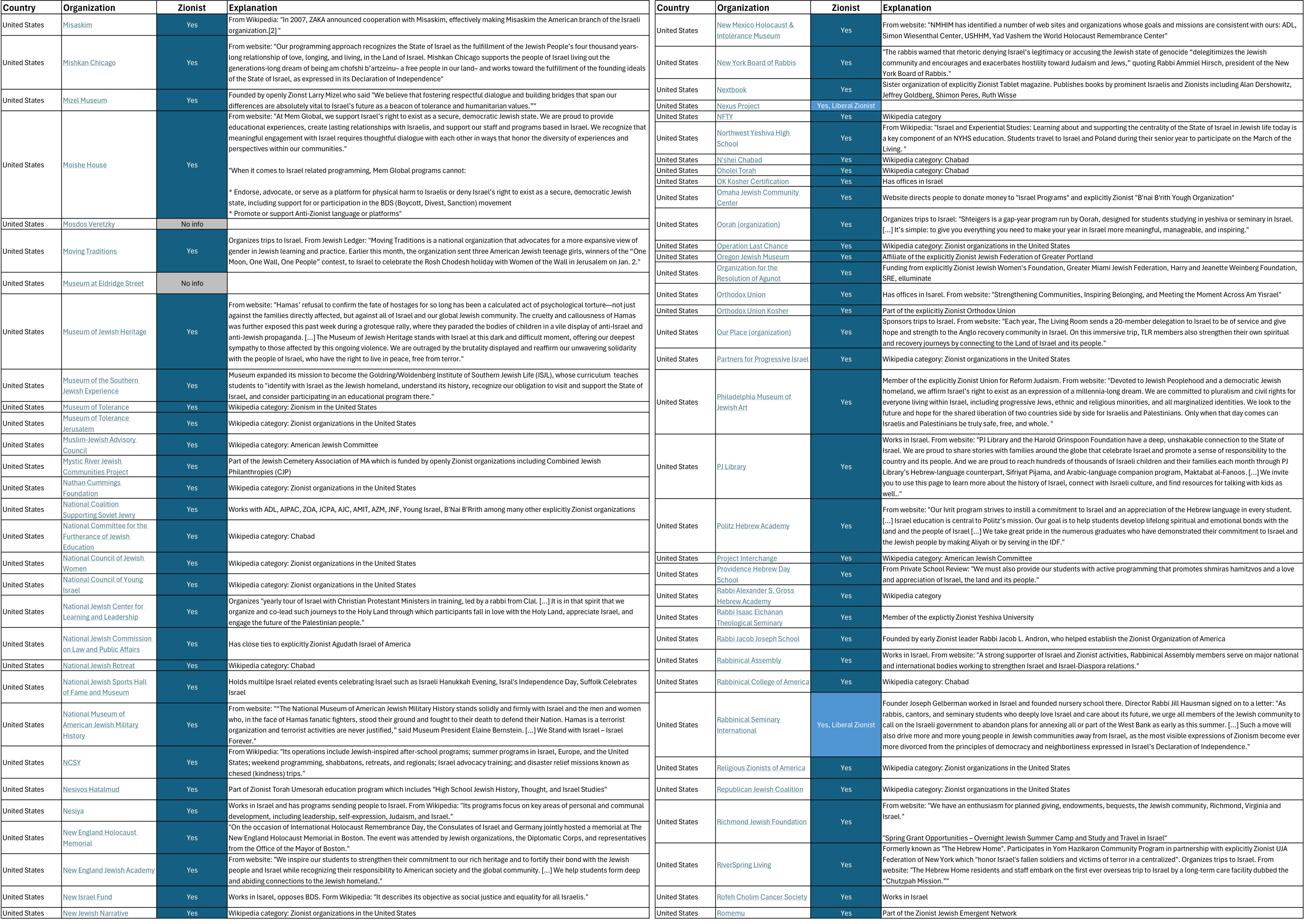
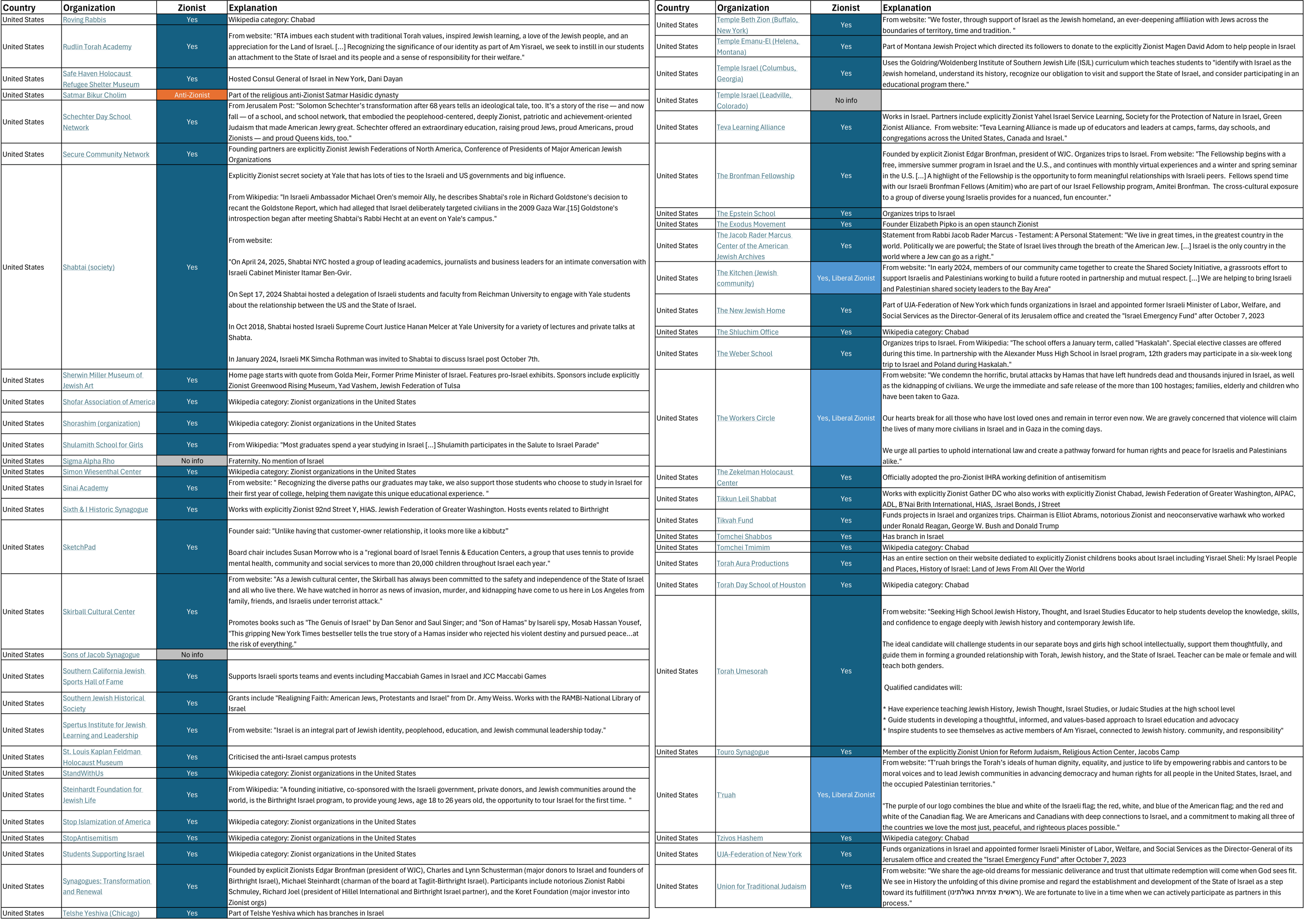
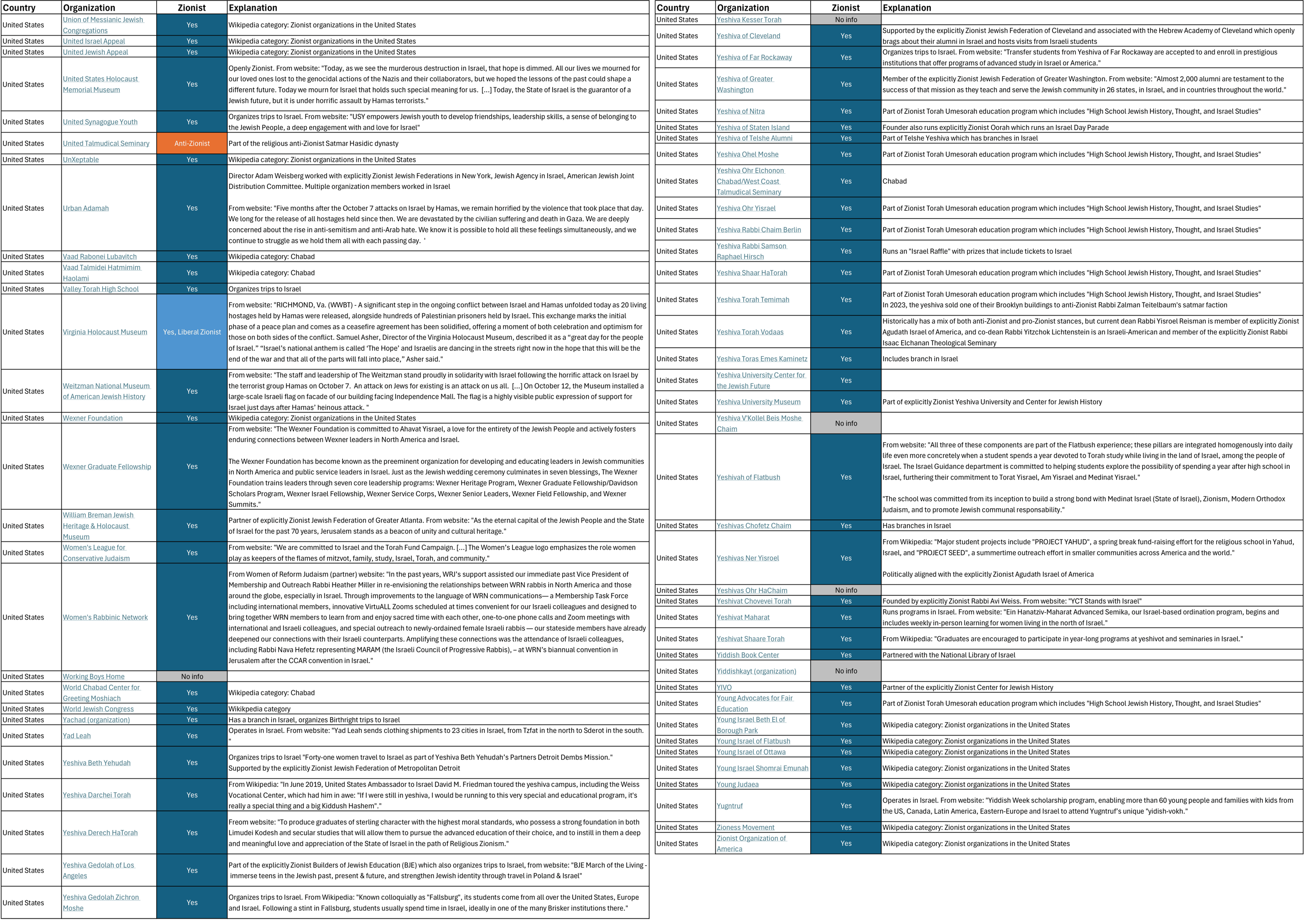
Analysis of Jewish-American organizations
A more in-depth analysis was carried out specifically of Jewish organisations in the U.S. from the Wikipedia category page for ‘Jewish organizations based in the United States’ as it represents the second largest population of Jews outside of Israel and plays a pivotal role in global Zionism. As of April 2026, the page lists approximately 487 organizations in this category and its sub-categories.
Of the 487 Jewish-American organizations examined, 459 had sufficient information to determine their stance on Zionism. Of those, 455 (99%) are Zionist—including liberal Zionist groups that make token references to Palestinians. Even excluding those, the figure remains around 90%. Only 3 or 4 organizations could be classified as non-Zionist or critical of Israel. The remaining 28 had no clear stance or insufficient information. Including those unknowns, the absolute minimum proportion of Zionist organizations is 93% (455/487).
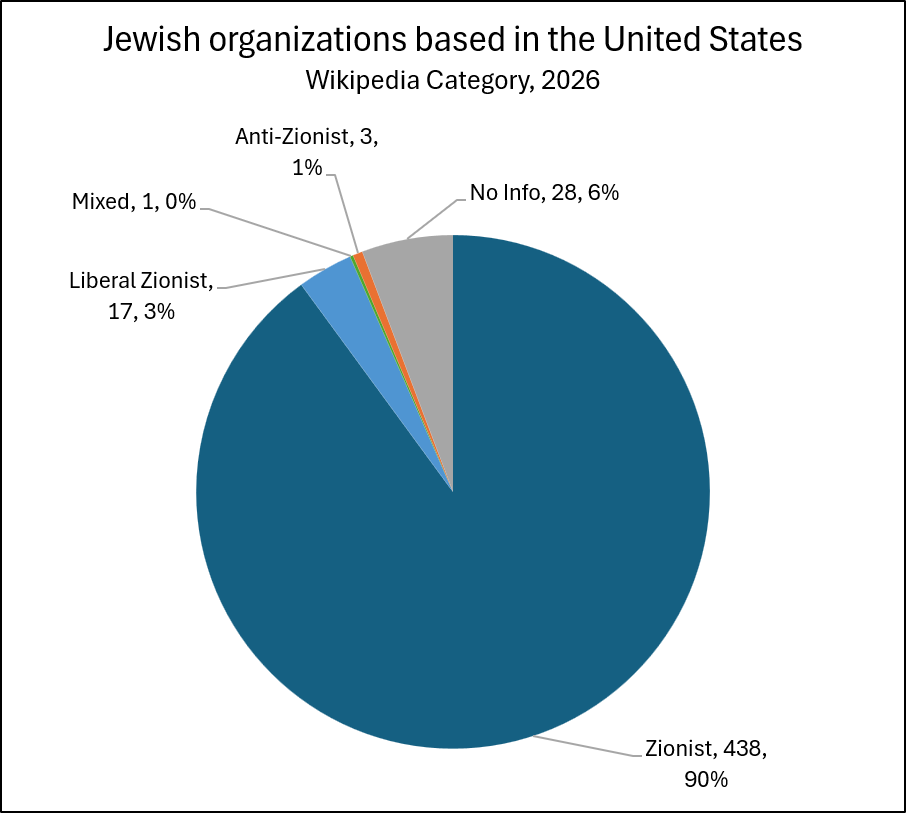
Below is a breakdown by some of the major secondary Wikipedia categories, showing how many organizations are Zionist out of the total in each category, including organizations with no discernible info:
Jewish community organizations based in the United States: 94% (67/71)
Jewish museums in the United States: 86% (61/71)
Holocaust museums in the United States: 95% (21/22)
Jewish-American political organizations: 97% (37/38)
Jewish history organizations based in the United States: 85% (63/74)
LGBTQ Jewish organizations based in the United States: 100% (5/5)
Jewish organizations based in New York (state): 93% (41/44)
Jewish women’s organizations in the United States: 80% (4/5)
Jewish youth organizations based in the United States: 100% (6/6)
It should be noted that when excluding organizations with no clear stance, all of these figures jump to 97-100%.
Community organizations and funding backbone
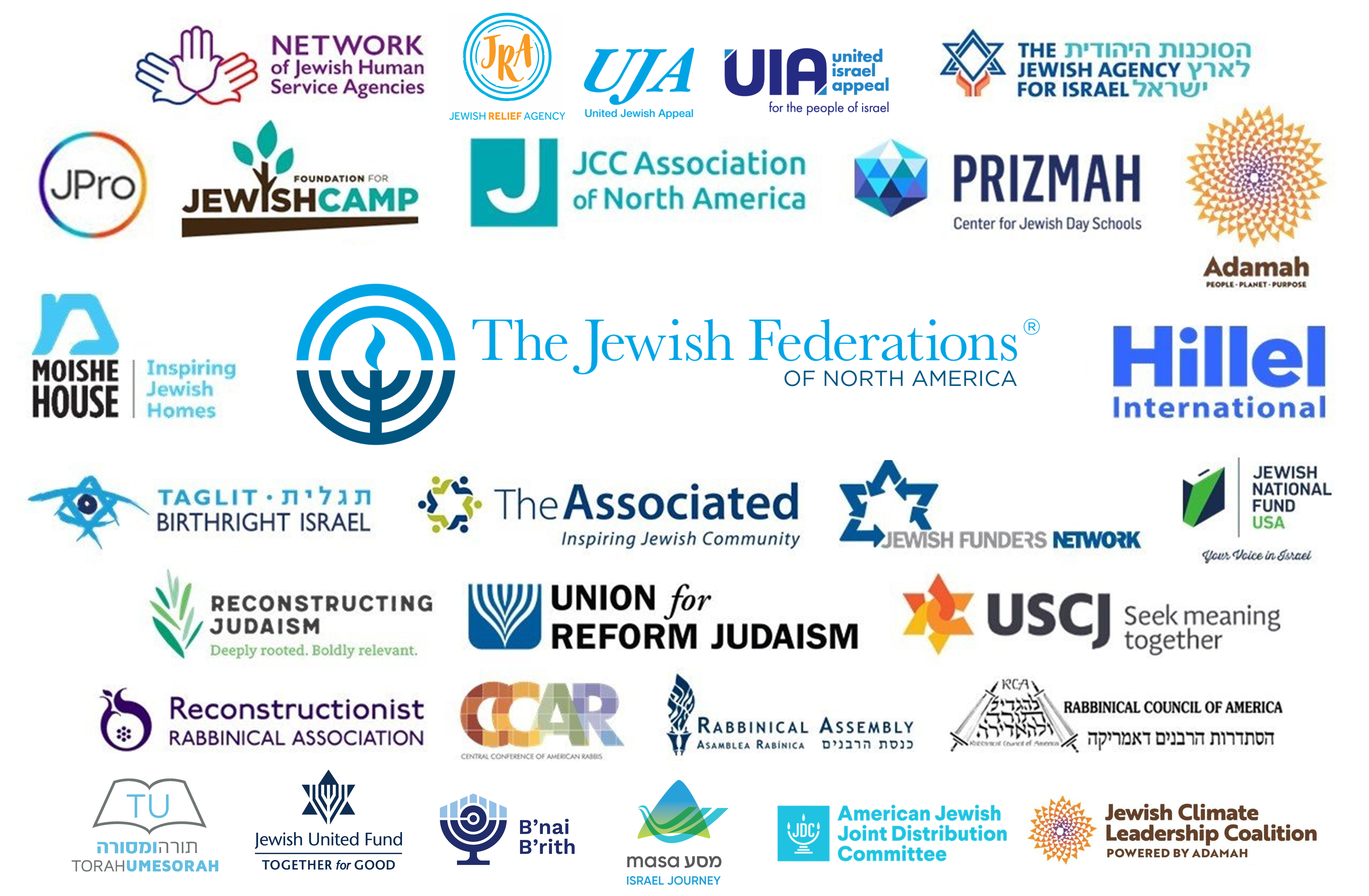
Many of these Jewish community organizations are funded by local branches of the Jewish Federations of North America (JFNA), an explicitly Zionist American-Jewish umbrella organization for the Jewish Federations system. The JFNA represents over 350 independent Jewish communities across the U.S. and Canada that raise and distribute over $2.3 billion annually through donations and endowment programs, supporting social welfare, social services, education, fundraising, organizational assistance, training, and leadership for Jewish communities.
Organizations directly related to the JFNA—such as the United Jewish Appeal (UJA), United Israel Appeal (UIA), United Jewish Communities, Conference of Presidents of Major American Jewish Organizations (CoP), and Combined Jewish Philanthropies (CJP)—along with similarly Zionist community organizations including the Jewish Community Centers Association of North America (JCC), American Jewish Joint Distribution Committee (JDC), Jewish Relief Agency (JRA), Jewish United Fund (JUF), and B’nai B’rith, all provide significant support to Jewish communities worldwide and are explicitly pro-Israel.
The JCC Association of North America serves as the umbrella organization for the Jewish Community Center movement, encompassing over 172 JCCs, Young Men’s/Women’s Hebrew Association Centers (YM-YWHAs), and camp sites in the U.S. and Canada. These institutions collectively serve over 1.5 million people weekly, including through “Israel-related programming” seminars and cultural events.
The JFNA is also a major funder of the Jewish Agency for Israel (JAFI), the largest Jewish non-profit organization in the world and the primary institutional link between Israel and Jewish communities worldwide. The Jewish Agency facilitates the immigration of Jews to Israel, a core Zionist function known as aliyah. As of 2026, the agency claims to have brought 3.5 million immigrants to Israel since 1948, a figure representing approximately half of Israel’s Jewish population today. Following the October 7, 2023 attacks, the JFNA reported record-breaking surges in fundraising and investment in Jewish communities and launched the Israel Emergency Campaign, which had raised nearly $1 billion as of late 2025 in an effort to “rebuild Israel.”
A 2024 study by CSS Fundraising surveyed 73 Jewish organizations (including synagogues). Among the Israel-focused organizations, 57% reported increased support to their annual fund after October 7, compared to only 19% of non-Israel-focused organizations.
Zionist dominance in education and trips to Israel
The dominance of Zionism among Jewish communities extends to educational institutions. Hillel International, which describes itself as the “largest Jewish campus organization in the world,” operates over 800 college and university campuses, provides extensive pro-Israel programming, employs post-graduate fellows from Israel sent by the Jewish Agency for Israel, and is a major partner of Birthright Israel, an organization that sponsors free, guided propaganda trips to Israel for Jewish youth designed to foster uncritical support to Zionism.
Even religiously focused schools are Zionist. Torah Umesorah is a major Orthodox Jewish educational charity that has developed a network of some 760 private Jewish day schools that teach more than 250,000 children. It has established yeshivas and kollelim in every city with a significant population of Jews. Many Torah-based Jewish day schools utilize the Torah Umesorah curriculum that includes “Jewish History, Thought, and Israel Studies” which states the purpose is to guide students “in forming a grounded relationship with Torah, Jewish history, and the State of Israel” and “inspire students to see themselves as active members of Am Yisrael.”

Since its founding in 1999, Birthright Israel has funded more than 900,000 educational trips to Israel and contributed over $2.3 billion to Israel’s economy through tourism and related spending. Longitudinal research conducted by the Cohen Center for Modern Jewish Studies at Brandeis University consistently finds that Birthright participants develop stronger attachment to Israel and greater engagement with Jewish communal life than comparable non-participants. A 2025 Brandeis study of Birthright’s Summer 2024 participants found that 71% of participants reported feeling “very much” connected to Israel after their trip, compared to 55% before participation. Results from the previous year showed a shift from 29% to 59% “very much” connected to Israel. The study also found that participants became significantly less likely to agree with claims that Israel was committing genocide and more likely to challenge such claims when encountered online or in conversation.
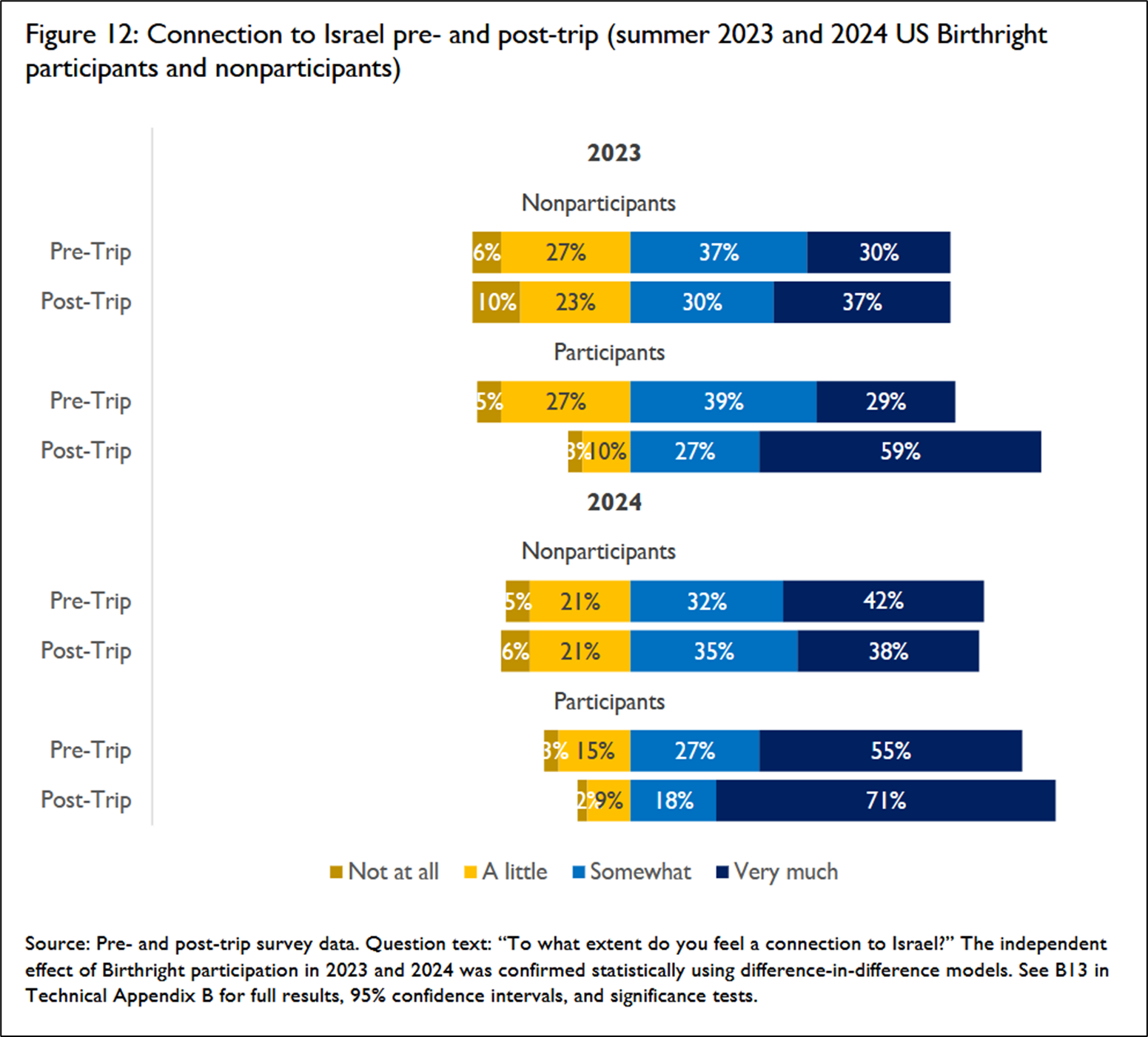
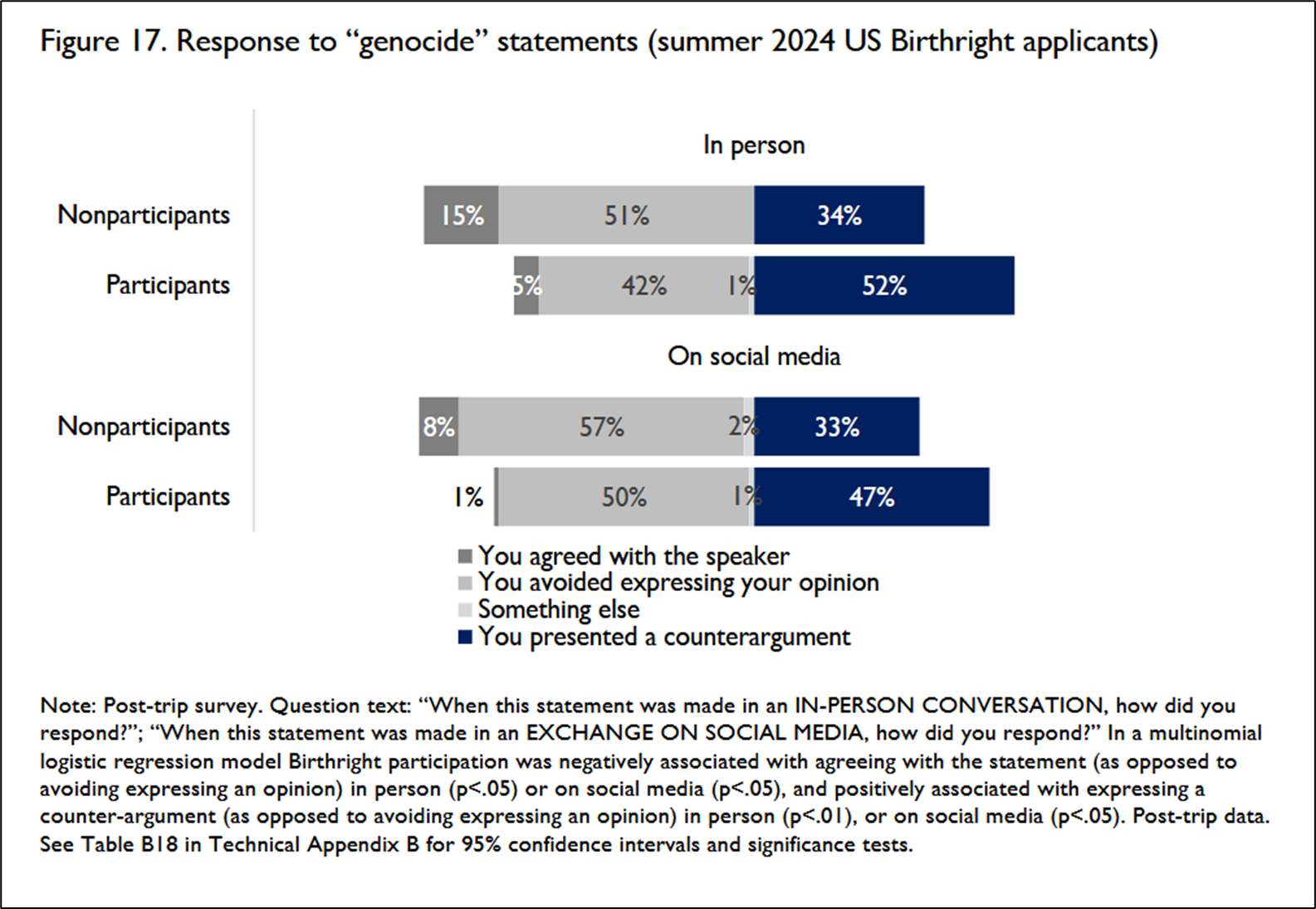
Many Jewish organizations, among their other functions, also arrange and sponsor trips to Israel, particularly aimed at Jewish youth outside of Israel. These include summer programs, gap years, study abroad, and volunteer opportunities, often working directly with Birthright Israel or following similar models. Major trip-sponsoring organizations include but are not limited to:
Masa Israel Journey: Young adults (18-30); Long-term (5-10 months): gap year, study, internship, volunteer
BBYO (B’nai B’rith): Teens; Summer and family trips to Israel
Young Judaea: Teens and young adults; Summer and gap year programs in Israel
Naale Elite Academy: High school students; Completing high school in Israel
Jewish Theological Seminary (JTS) and its undergraduate school List College: College students; Study in Israel programs
United Synagogue Youth (USY): Conservative teens; Israel Pilgrimage and Israel Adventure
National Conference of Synagogue Youth (NCSY): Orthodox teens; Summer Israel programs
The North American Federation for Temple Youth (NFTY): Reform teens; Adventure, Mitzvah Corps, Sci-Tech Israel
Jewish Women’s Renaissance Project (JWRP): Mothers; ”Momentum” trips to Israel
Hebrew Theological College (HTC): College students; Israel study programs
The Bronfman Fellowship: High school students; Israel-based leadership fellowship
Volunteers for Israel (VFI): Adults (17+); Volunteer work on IDF logistics bases
Association for Jewish Studies (AJS): Academics; Academic conferences and exchange in Israel
American Guild of Judaic Art (AGJA): Artists; Israel-based art programs
Hadassah: Women; Women’s missions to Israel
Shorashim: Teens and adults; “Pluralistic” immersive Israel experiences
Our Place: Young adults; Religious/Zionist educational trips
Oorah: Orthodox families; Israel trips for families and children
Synagogue support for Israel and the IDF
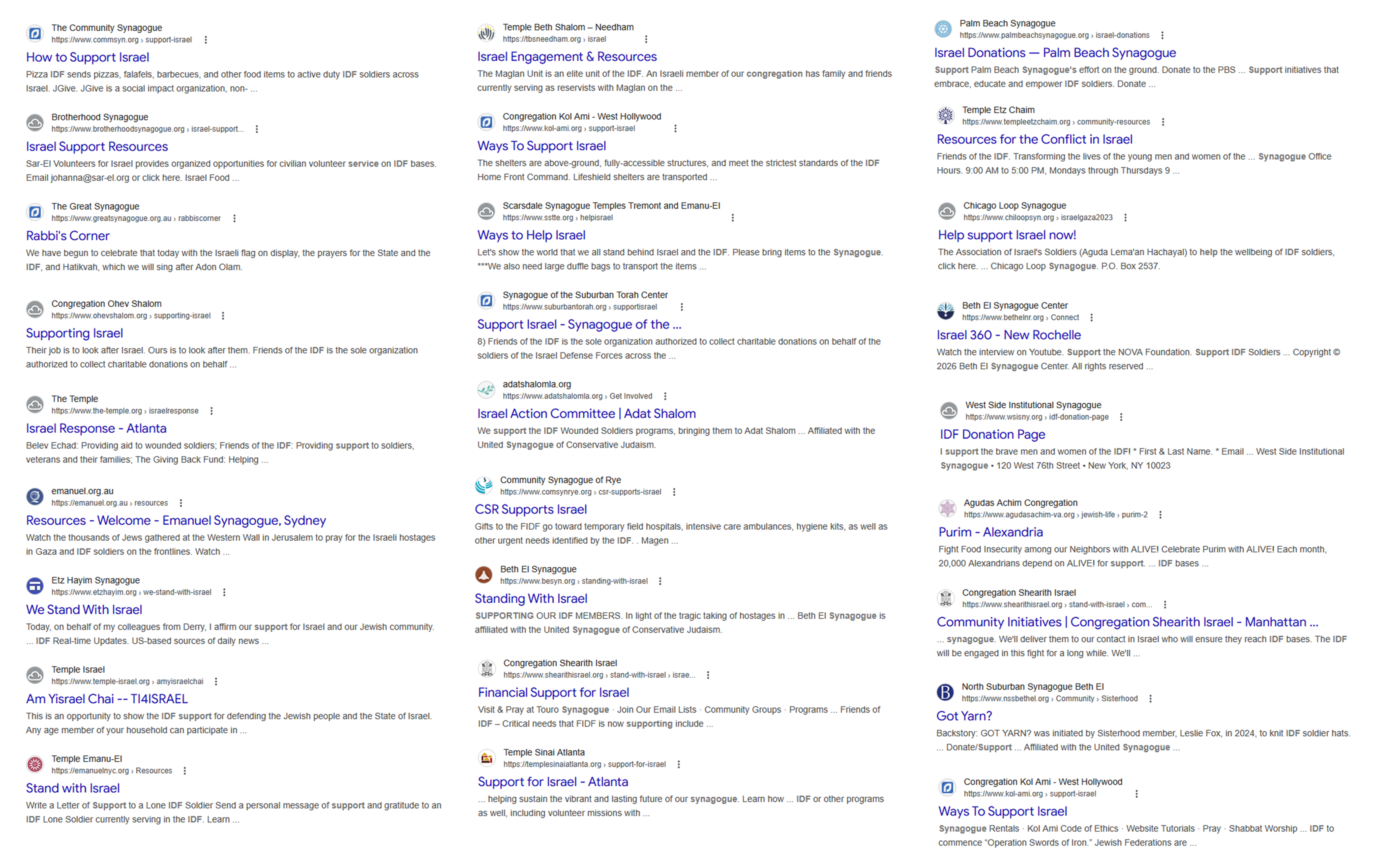
Beyond educational institutions and community organizations, American synagogues represent another important pillar of institutional Zionist support. While a small minority of anti-Zionist congregations exist, the vast majority actively support Israel and, in many cases, the Israel Defense Forces (IDF) directly, and even host events for the illegal sale of Palestinian land. Synagogues also donate money to Israel through emergency medical services such as United Hatzalah and American Friends of Magen David Adom, Israel’s version of the Red Cross.
In a 2025 NPR interview with an “Anti-Zionist” synagogue in Chicago, the lead Rabbi of the Tzedek Chicago synagogue estimated about 30 anti-Zionist congregations or prayer groups in the U.S. Only four synagogues around the U.S. have publicly taken an anti-Zionist political stance: Tzedek Chicago, V’ahavatah in Boston, Makom in North Carolina, and Beyt Tikkun in the Bay Area. For reference, there are over 3,800 synagogues in the U.S.; these figures are insignificant, representing about 0.1% of all American synagogues.
Major congregations such as Park Avenue Synagogue in New York (the largest Conservative synagogue in the city, with nearly 2,000 families) and Central Synagogue in New York (the largest Reform congregation in the city) have rabbis who are proud self-described Zionists and have raised millions for Israeli causes following October 7, 2023. New York is home to the largest number of Jews outside of Israel and a key pillar of outside support for Israel. Within just a few days after the attack, American synagogues raised $105 million for UJA-Federation of New York’s Israel Emergency Fund, including:
Park Avenue Synagogue (Conservative) raised $18 million
Central Synagogue (Reform) raised $15 million
Congregation Kehilath Jeshurun (Modern Orthodox) raised $7 million
Temple Emanu-El (Reform) raised $300,000 and purchased an ambulance for the American Friends of Magen David Adom
Stephen Wise Free Synagogue (Reform) raised $100,000
Lincoln Square Synagogue (Orthodox) raised “tens of thousands”
B’nai Jeshurun (nondenominational) conducted letter-writing initiatives to Israeli soldiers, collected donations, and included list of vetted charities
As of September 2025, the total figure has raised to over $300 million.
Other synagogues have established formal partnerships with the Friends of the Israel Defense Forces (FIDF), a U.S.-based non-profit that connects American Jewish communities with IDF soldiers. FIDF, which has raised over $1 billion since its founding and maintains 25 chapters across the United States with more than 150,000 donors, works directly with U.S. synagogues to build and renovate synagogue facilities on IDF bases in Israel. New Synagogue in Palm Beach, Florida, for example, has dedicated official IDF Torah covers and donated Torah scrolls to Israeli military units. Congregation Shaarey Zedek of Southfield, Michigan promotes the FIDF emergency campaign and maintains a prayer list for IDF soldiers. Prominent FIDF donors Leo and Ruth David donated the 350-seat “Or Olam” Synagogue at Camp Ariel Sharon, the largest synagogue on any IDF base.
Synagogues sell stolen Palestinian land
Across North America, a network of synagogues has become complicit in the illegal sale of Palestinian land by hosting real estate events for Israeli settlement companies. Organizations such as My Home in Israel organize annual “Great Israeli Real Estate Events” at synagogues including Park East Synagogue in Manhattan, Young Israel of Midwood in Brooklyn, and Adas Torah in Los Angeles. These events market properties in illegal West Bank settlements such as Gush Etzion, Ariel, Efrat, Kfar Eldad, and Karnei Shomron, land widely considered stolen under international law, as Israeli settlements in the occupied territories violate the Fourth Geneva Convention.
The Palestinian Assembly for Liberation (Pal-Awda) and other activist groups have organized protests outside these synagogues, condemning the sale of stolen Palestinian land. However, rather than face accountability, these events are shielded by a powerful protection racket: critics are immediately labeled antisemitic, and law enforcement is deployed to protect the synagogues and their events while cracking down on protesters.
When protests erupted outside Adas Torah in Los Angeles in June 2024, the response from political leaders was swift and uniform. President Joe Biden declared himself “appalled,” calling the protest “antisemitic and un-American,” while California Governor Gavin Newsom and Mayor Karen Bass echoed the condemnation. Los Angeles Mayor Karen Bass vowed “enhanced partnerships with Jewish public safety organizations” and expedited $40 million in grant funding for security measures at houses of worship.
In May 2026, New York Mayor Zohran Mamdani, despite claiming to oppose the land sales as “illegal under international law,” ordered the NYPD to enforce “buffer zones” around the Park East Synagogue in Manhattan hosting a real estate event, effectively pushing protesters away from the events while protecting the real estate sales inside. The New York Civil Liberties Union criticized these buffer zones as “no-speech zones” that undermine First Amendment rights. Meanwhile, the Anti-Defamation League and politicians like New York City Council Speaker Julie Menin condemned protesters’ “hateful rhetoric,” with Menin claiming that “calls for the destruction of Israel” and “glorification of Hezbollah” fuel antisemitism, accusations that activists reject as deliberate mischaracterizations meant to conflate anti-Zionist protest with Jew-hatred.
In addition, it should be noted that the properties and land advertised at these real estate events are reserved exclusively for Jews. Julian Shapiro, owner of My Home in Israel, has admitted as such to The New York Times. Protesters who registered for events organized by Home in Israel and My Home in Israel say that they were explicitly asked to provide information regarding their religious affiliation and either granted or denied entry accordingly. The events request from potential buyers the names of their “shul [synagogue] and rabbi.” This would mean that these events are in violation of the Fair Housing Act of 1968 which outlaws such “housing covenants.” Yet these realtors have faced no consequences, but rather protection.

Congregational participation in pro-Israel advocacy extends beyond direct IDF support. Over 50 Jewish institutions in Atlanta, including major synagogues, day schools, and communal groups, wrote a letter publicly opposing votes to withhold certain arms from Israel. Jews nationwide participated in the March for Israel demonstration organized by JFNA in Washington D.C., which drew nearly 300,000 participants including synagogues (Society Hill Synagogue, Shaare Torah, Agudath Israel of America to name a few). Israel Solidarity Days, coordinated through local Jewish Federations and Jewish United Fund (JUF), list dozens of synagogues as supporting partners.
While no central database of pro-Israel synagogues exists, the documented activities of major congregations, their formal partnerships with FIDF, their participation in emergency fundraising campaigns, and their public political advocacy demonstrate that synagogue-based support for Israel and the IDF is not fringe but normative across American Jewish denominational movements, from Orthodox to Reform to Conservative.
Purging of dissent within organizations
Jewish institutions and synagogues routinely purge staff who criticize Israel, with even the smallest dissent often met with unemployment. A months-long investigation by In These Times, published in October 2024, interviewed 18 Jewish professionals from 16 different organizations across the United States who were fired, resigned under pressure, or saw their positions eliminated after October 7, 2023, for criticizing Israel or supporting a ceasefire in Gaza. Among their reported transgressions: attending a protest, wearing a keffiyeh to work, or simply liking an Instagram post.
Documented cases include:
Lizzie Burdock (pseudonym), a Hebrew education school director at a synagogue in New England, was fired after a clip of her singing at a ceasefire protest appeared on local news. Her bosses asked her directly: “Are you an anti-Zionist?”
A volunteer coordinator at a Baltimore County synagogue was let go shortly after being seen at a demonstration. B. Ever Hanna, who worked as a director of chesed (loving kindness) at Chizuk Amuno, was fired two weeks after being arrested at a Jewish Voice for Peace protest.
Adam Gottlieb, a Sunday school teacher at Makom Solel Lakeside in Highland Park, Illinois, was fired 27 hours after showing his teenage students a video of a Palestinian comedian.
A veteran camp counselor at Camp Ramah in New England was told she would not be invited back after a Zoom call in which the CEO asked: “Do you really believe Israel is committing genocide?” and “Do you believe Israel has a right to exist?”
Rabbi Lonnie Kleinman was fired from her Philadelphia position for Base, a project of the larger Jewish non-profit Moishe House, after attending a protest with Jewish Voice for Peace (JVP). Her supervisor wrote that “the definition of a Base rabbi is that the personal is the professional.”
Dan Fischer, a Hebrew and Jewish ethics teacher at Sinai Synagogue in South Bend, Indiana, was fired the day after he was quoted at a rally saying: “I know that my tradition, the Jewish tradition, is a religion of tzedek, meaning justice, and shalom, meaning peace.” The synagogue’s rabbi claimed Fischer was “not being respectful or compassionate” to grieving Israelis.
The Jewish United Fund of Metropolitan Chicago (JUF), a major fundraising and oversight body closely affiliated with the Jewish Federation of Metropolitan Chicago, which holds nearly $1 billion in assets, appears at the center of two of the most revealing cases.
At Mishkan Chicago, a “Progressive Jewish” congregation that receives funding from the Jewish Federation of Metropolitan Chicago, at least 20% of the staff departed, either fired or resigned with several saying they were pushed out in the roughly nine-month period after October 7. For at least two employees, it had to do with the keffiyah. The main figure who issued the complains was Max Averbukh whose wife Jane Charney is an associate ice president at the Jewish United Fund of Metropolitan Chicago (JUF) which is closely affiliated with the Jewish Federation. Donors threatened to pull $50,000 to $100,000 in funding.
An even more direct example of JUF’s policing power involved an employee at Metro Chicago Hillel, whose transgression was simply liking two Instagram posts from Jewish Voice for Peace (JVP) on a personal account. JUF’s HR department in a confidential memo cited violation of JUF’s conflict of interest policy listing “anti-Zionist agenda” alongside “the Ku Klux Klan” and “the American Nazi Party” as prohibited affiliations. The employee was told that the “perception of being pro-Palestinian was enough to fire.” and that Hillel staff were asked to attend pro-Palestinian events and report back to their executive director or JUF officials, effectively acting as monitors of campus activism.
What the Mishkan and Hillel cases reveal is a funding pipeline that enforces ideological conformity. The Jewish Federation of Metropolitan Chicago, closely affiliated with JUF, holds nearly $1 billion in assets and gave more than $175 million in grants in 2022, including approximately $85,000 to Mishkan. JUF’s HR department directly investigates and terminates employees at JUF-funded institutions like Hillel. And individual JUF executives’ spouses can, through donor complaints, trigger staff purges at progressive synagogues like Mishkan. As Rebecca Vilkomerson, co-director of Funding Freedom, told In These Times: “Liberal Zionist funders, which often funded progressive or left organizations across many issue areas, are now imposing litmus tests over using words like ‘genocide’ through funding cuts, threatening cuts, or quiet non-renewals.”
IHRA definition adoption among organizations
An additional mechanism for institutionalizing Zionist orthodoxy has been the widespread adoption of the International Holocaust Remembrance Alliance (IHRA) definition of antisemitism. According to a report from the Center for the Study of Contemporary European Jewry, over 1,200 governments and institutions globally had adopted or endorsed the IHRA definition as of mid-2024, including 533 NGOs and 347 educational institutions.
Of the 11 “working examples” the IHRA provides of what constitutes antisemitism, 7 relate directly to criticism of Israel —including “denying the Jewish people their right to self-determination” (i.e., opposing Zionism), “applying double standards to Israel,” and “drawing comparisons of contemporary Israeli policy to that of the Nazis.” Critics argue that the IHRA definition, in practice, conflates legitimate political speech about Israel’s actions with antisemitism, effectively chilling or censoring criticism of Israeli government policies.
Leading Jewish bodies have actively lobbied for the codification of the IHRA definition into U.S. law. The Jewish Federations of North America (JFNA), Anti-Defamation League (ADL), and Jewish Council for Public Affairs (JCPA) have all supported U.S. legislation incorporating IHRA definitions into anti-discrimination law. This has real-world consequences: universities, federal agencies, and state governments that adopt the IHRA framework apply its Israel-related examples when adjudicating complaints, meaning that students or faculty who sharply criticize Israel can be investigated for antisemitism under federal civil rights law.
Conclusion
From synagogue demographics, organizational analysis, funding structures, educational programming, travel sponsorships, the measurable impact of Birthright Israel, and the legal codification of the IHRA definition, the evidence points to an unmistakable conclusion: Zionism is not merely a dominant ideology within Jewish institutional life; it is functionally hegemonic. Less than 1% of synagogues in the U.S. identify as anti-Zionist. Over 90% of Jewish organizations worldwide with clear public stances are explicitly Zionist. The financial backbone of the Jewish-American community, the JFNA, channels over $3 billion annually through an explicitly Zionist framework. Major institutions, synagogues, charities, schools, and museums all incorporate pro-Israel programming as a core mission component.
The result is an institutional environment in which even mild criticism of Israel can lead to professional consequences, in which the dominant definition of antisemitism centers criticism of Israel as a primary example of Jew-hatred, and in which Jewish youth are systematically exposed to pro-Israel educational and travel experiences that measurably shift their political views to become more pro-Israel.
Further reading:
Burley, S. (2024, October 1). U.S. Jewish Institutions Are Purging Their Staffs of Anti-Zionists. In These Times. https://inthesetimes.com/article/anti-zionist-israel-gaza-jewish-institutions
Finkelstein, M. (2026, May 14). Synagogues that sell stolen Palestinian land should, of course, be protested. Mondoweiss. https://mondoweiss.net/2026/05/synagogues-that-sell-stolen-palestinian-land-should-of-course-be-protested/
Rose, T. (2026, June 17). Israel Inescapable, Part I: The Synagogue. Long Liberation Day. https://liberationday.substack.com/p/israel-inescapable-part-i-the-synagogue
The figures in this post, checked
Each figure was checked against the source Tariq cited. Open a topic to see the source's own wording for every figure.