Institutional Jewish Exceptionalism
In the U.S., antisemitism is treated with unique urgency by Congress and universities, prompting a flood of targeted legislation and legal settlements that elevate it above all other forms of bigotry.

NOTE: This is an excerpt from a longer article:
Jewish exceptionalism in Congress

Within the U.S. in particular, along with the Holocaust, antisemitism is put up on a pedestal as some unique form of bigotry. This idea is enforced top-down by the federal government. The U.S. Senate has had multiple hearings and legislative measures focused exclusively on antisemitism, isolating it from any other form of bigotry. This includes, but is very much not limited to:
Senate Resolution 296 to condemn antisemitism (Jun 2025)
Commission to Study Acts of Antisemitism in the United States Act (Jun 2025)
Stop Antisemitism on College Campuses Act (Mar 2025)
Columbia Act of 2025 (Feb 2025)
Antisemitism Awareness Act of 2025 (Apr 2025)
House Resolution 1449 to condemn global antisemitism (Sep 2024)
Amendment 3276 to create National Coordinator to Counter Antisemitism and Interagency Task Force (Sep 2024)
Countering Antisemitism Act (Apr 2024)
Antisemitism Awareness Act (Oct 2023)
U.S. National Strategy to Counter Antisemitism (May 2023)
HEAL Holocaust Education and Antisemitism Lessons Act (Jan 2023)
Executive Order on Combating Anti-Semitism (Dec 2019)
Global Anti-Semitism Review Act (Apr 2004)
The Southern Poverty Law Center opposed the Countering Antisemitism Act (Apr 2024), legislation passed by the House in the 118th Congress, as it not only conflates criticism of Israel as ‘antisemitism,’ but also because of its narrow approach, stating that “No one form of hate should be privileged over others. Efforts that isolate antisemitism from other forms of bigotry, such as anti-Black and anti–Asian racism and other forms of discrimination, fail to prevent and address the root causes of prejudice, hate, and bias-motivated criminal activity.” As a rough estimate, from search results for “antisemitism” on GovTrack as of August 2025 show a total of 362 bills introduced.
In contrast, other groups such as Black Americans, Native Americans, Asian Americans, and Muslims rarely get their own isolated hearings and bills. Rather they are generally lumped in with all other broader forms of hate crimes. The rare exceptions, two notable examples include the Combating International Islamophobia Act introduced in 2021 that continues to be stalled and reintroduced as of 2025; the Emmett Till Anti-Lynching Act introduced in 2018 and only signed in 2022 (67 years after the lynching of black teenager Emmet Till) after hundreds of failed attempts to pass such a bill for over a century.
Jewish exceptionalism in colleges
Following the Gaza genocide, multiple universities in the U.S. have been sued by Jewish students and organizations over claims of “antisemitism on campus” from student protests since 2023. At least three major universities have paid monetary federal settlements to Jewish students and professors, with others pending:
Columbia University agreed to pay $221 million over three years to the U.S. government to settle federal investigations into antisemitism with an additional $21 million paid to Jewish faculty and staff after the government threatened to cut $400 million in grants.
University of California, Los Angeles (UCLA) was ordered by the federal government to agree to a $6.45 million settlement, including $50,000 each to the Jewish students who sued UCLA, and an additional $2.33 million to eight Jewish organizations and $320,000 to expand initiatives to “combat antisemitism.”
Harvard University agreed to pay an undisclosed amount to Jewish students and committed to adopting the IHRA definition, enhancing anti-antisemitism policies, and providing training and oversight.
Barnard College settled a lawsuit brought by Jewish students with an undisclosed amount, including a suite of policy reforms such as banning masked protests and agreeing to not meet with pro-Palestine groups.
New York University settled a federal lawsuit with Jewish students with an undisclosed amount.
UC Berkeley, MIT, and others are facing lawsuits brought by Jewish students with some already having approval from federal judges.
Brown University came to an agreement in 2025 with the federal U.S. government to take steps to make Jewish students “feel welcome,” including outreach to Jewish day schools to inform students about applying to Brown, renewing “partnerships with Israeli academics and national Jewish organizations,” convening the campus community for a celebration of Jewish life and ensuring robust education about Israel and a thriving Judaic Studies Program. Ironically, the agreement prohibits the university from using “diversity narratives” in admissions or from trying to achieve race-based outcomes or diversity targets. Essentially, the ‘anti-DEI’ (diversity, equity, and inclusion) Trump administration is removing DEI programs but allowing an exception for Jews only. The deal is to cost the university $50 million over a decade.
Brown University, like many other American universities, was funded by the transatlantic slave trade. The university was founded by the Brown family who accrued wealth directly and indirectly from the slave trade and labor of enslaved people. It’s an Ivy League college and one of the most prestigious universities in the world, with an endowment of $7.2 billion and a budget of $1.28 billion. In 2003, the university established a steering committee to investigate these ties to slavery, and four years later, Brown agreed to fund $10 million endowment for Providence Public Schools, amounting to $400,000 to $500,000 each year. As of 2020, 17 years after the issue was brought up, only $1.9 million was raised. It should be noted that less than 15% of Providence Public Schools students are ‘Black or African American’, with the majority 67% being ‘Hispanic/Latino.’
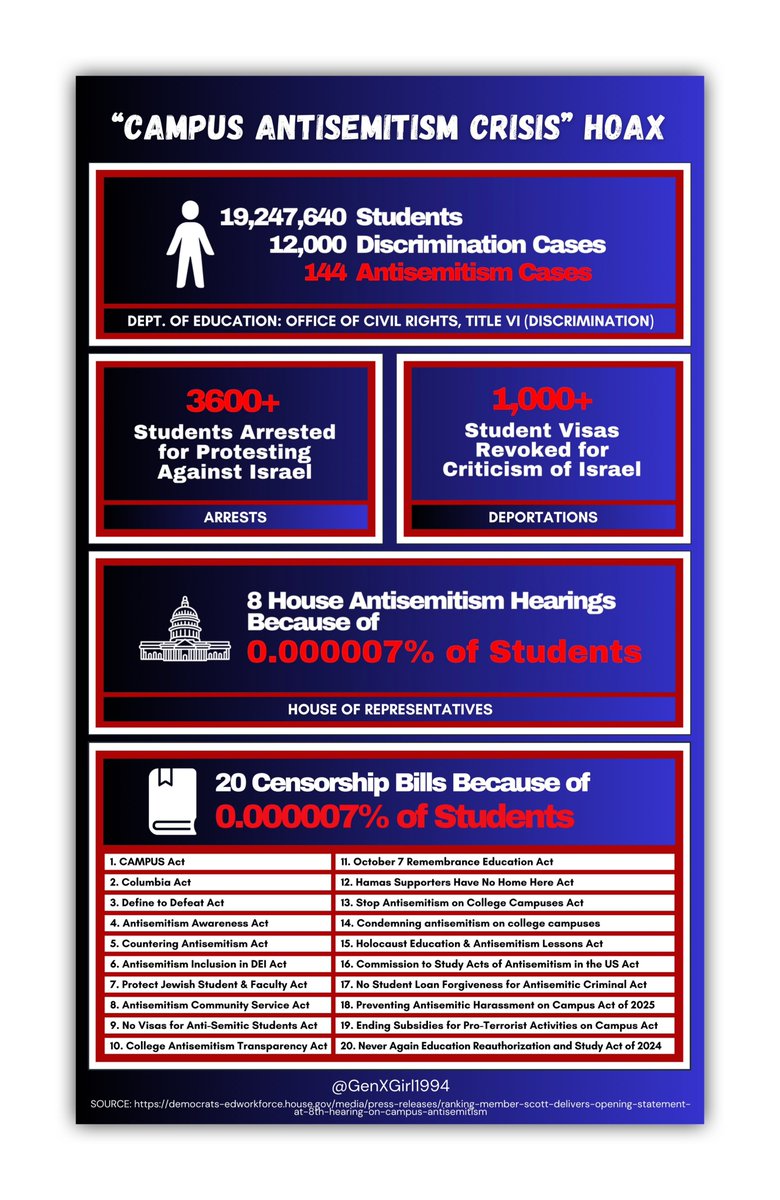
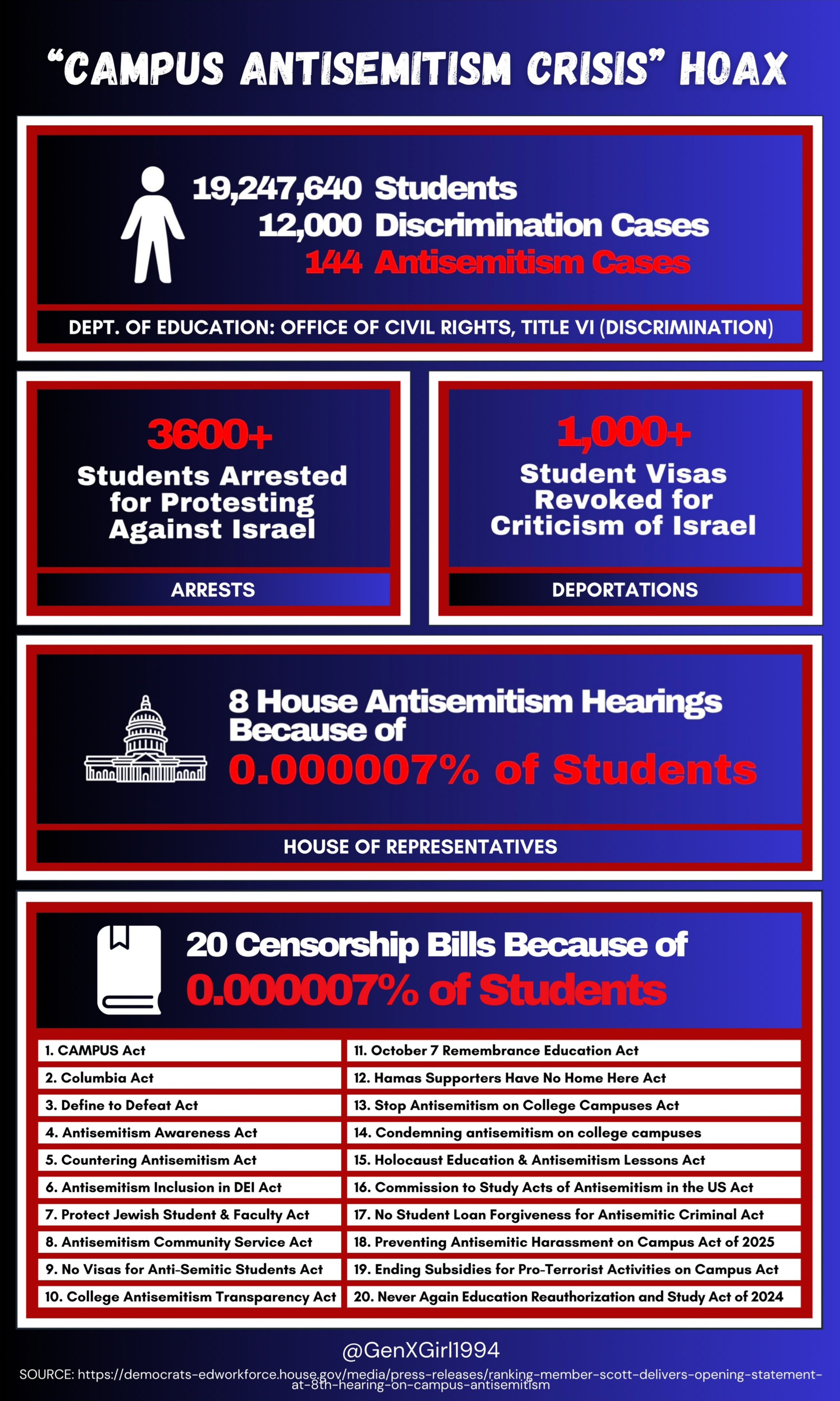
Ranking Member of the House Education Committee Bobby Scott noted a huge disparity between the special attention brought towards ‘antisemitism’ cases in college compared to all other forms of discrimination that should all fit under the same Title VI of the Civil Rights Act of 1964. He noted that despite a mere 144 out of a total of over 12,000 open cases alleging discrimination and violation of the title were related to antisemitism, the House was holding its eighth hearing regarding antisemitism on college campuses.
Substack and X user @GenXGirl1994 summarized the following based on her findings as of May 2025 in her article and thread, Manufactured Campus Antisemitism Crisis, that despite these antisemitism cases representing only 1% of the total open cases:
3,600+ students have been arrested for protesting against Israel
1,000+ student visas have been revoked for criticism of Israel
8 House antisemitism hearings have been held
20 censorship bills have been introduced
Further reading:
GenXGirl [@GenXGirl1994]. (2024, May 11). Manufactured Campus Antisemitism Crisis. [Post]. X. https://x.com/GenXGirl1994/status/1921559175403917690 Archived:
https://threadreaderapp.com/thread/1921559175403917690.html Substack: https://genxgirl.substack.com/p/manufactured-campus-antisemitism
The figures in this post, checked
Each figure was checked against the source Tariq cited. Open a topic to see the source's own wording for every figure.