Jews vs Roma: Perceived vs Real Marginalization
Comparing the historical persecution of Jews and Romani in Europe shows how Roma faced worse treatment yet lack the same recognition and reparations for their Holocaust and continuing oppression.

NOTE: This is an excerpt from a longer article:
It should be emphasized that, both historically and in the present day, Romani people in Europe have been treated worse than Jews. While Jews endured expulsions, pogroms, and restrictions on occupations, Romani communities were subjected to centuries of chattel slavery in parts of Eastern Europe, from their arrival in the 13th–14th centuries until the mid-1800s.
Although Jews were segregated and scapegoated, they were generally permitted to form semi-stable communities. Romani people, by contrast, were criminalized as a people, denied the right to settle, and often treated as permanent outsiders. As Jews gradually gained emancipation starting in the late-1700s, many were able to assimilate into middle-class society, pursue higher education, and achieve positions of prominence in Europe. Romani people, however, remained systematically marginalized, excluded from these paths of advancement even after the official end of their enslavement in 1856.
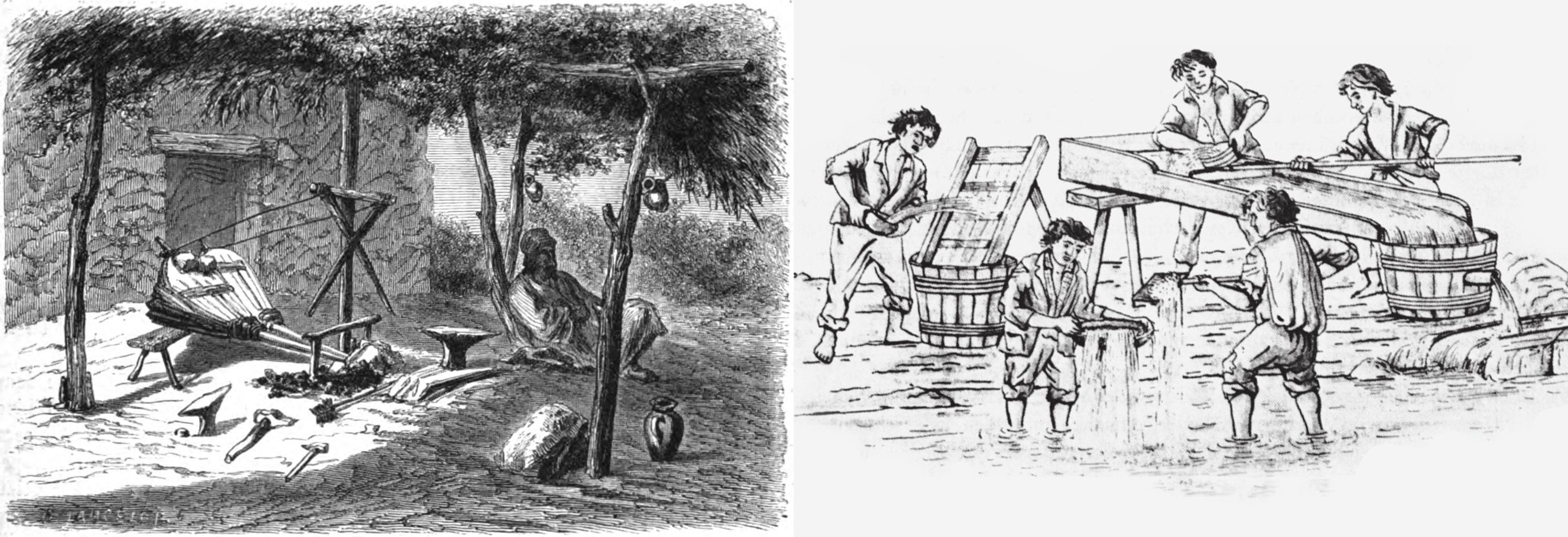
Up to 75% of the entire Romani population in Nazi-controlled Europe was exterminated by the Nazis. While Jewish survivors received immediate recognition and unprecedented reparations from multiple governments, organizations and private corporations around the globe, Romani survivors have received nothing from Germany, nor any other government or major organization, and have never been compensated for centuries of slavery or for their genocide under the hands of the Nazis.
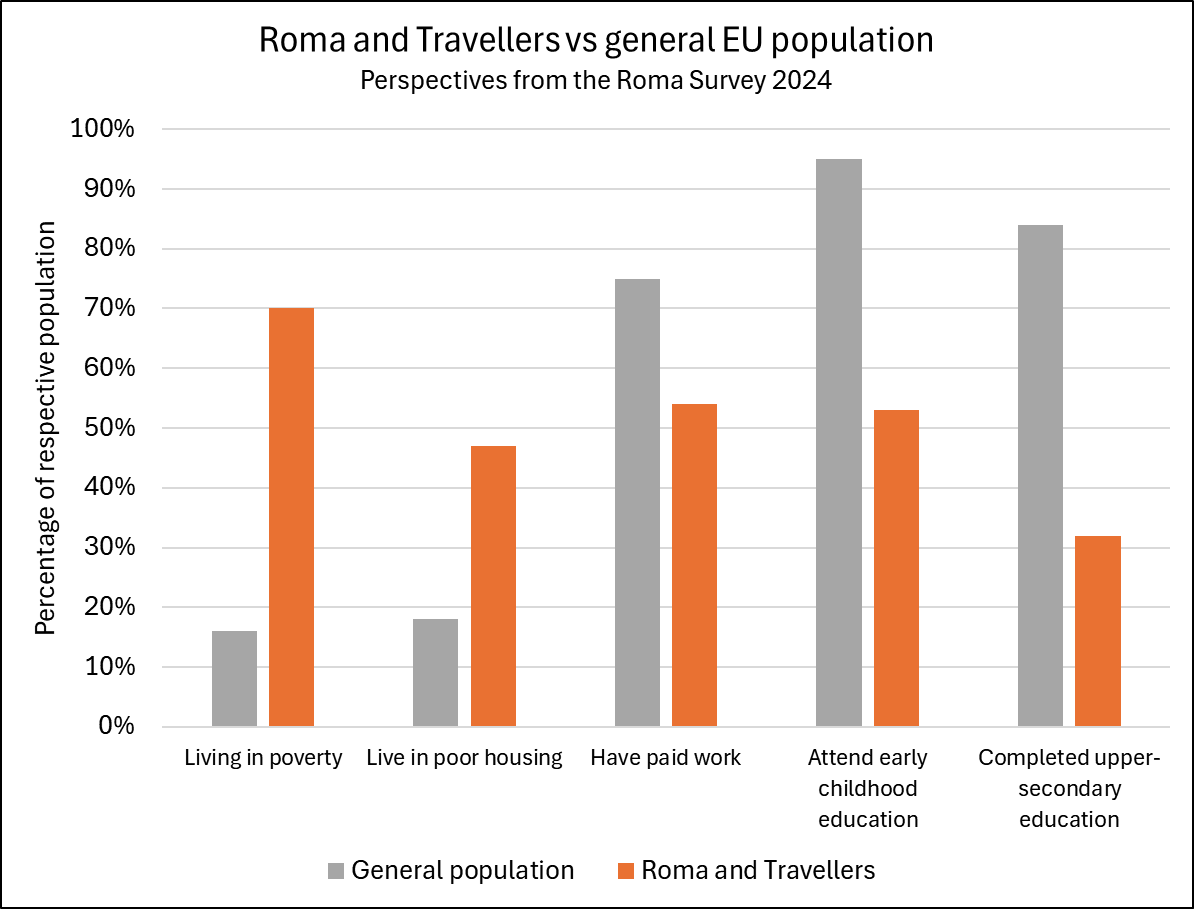
Today, Romani communities remain among the most marginalized populations in Europe, facing persistent poverty, discrimination, segregation, and institutional exclusion, often classified as ‘third-class citizens.’ An Amnesty International report from 2011 stated that “systematic discrimination is taking place against up to 10 million Roma across Europe. The organization has documented the failures of governments across the continent to live up to their obligations.” According to an EU Agency for Fundamental Rights (FRA) Roma Survey 2024 survey of Roma and Travellers in the European Union:
70% live in poverty, compared to 16% for the general population
47% live in poor housing or without proper sanitation compared to 18% for the general population; 83% live in overcrowded housing
53% attend early education and 32% finish upper education compared to 95% and 84% for the general population
54% have paid work, compared to 75% for the general population
36% experience discrimination when seeking work, more than double 2016
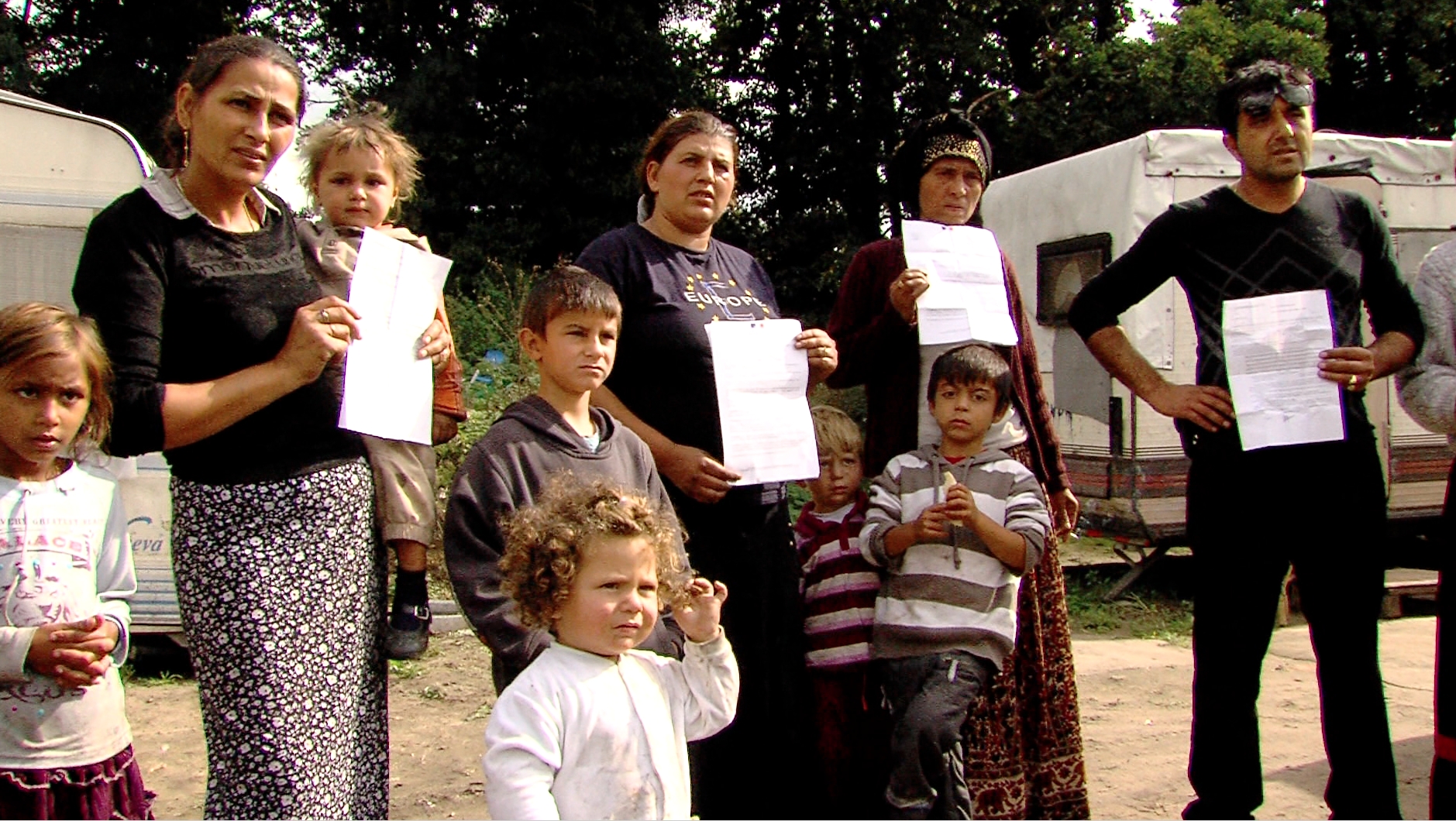
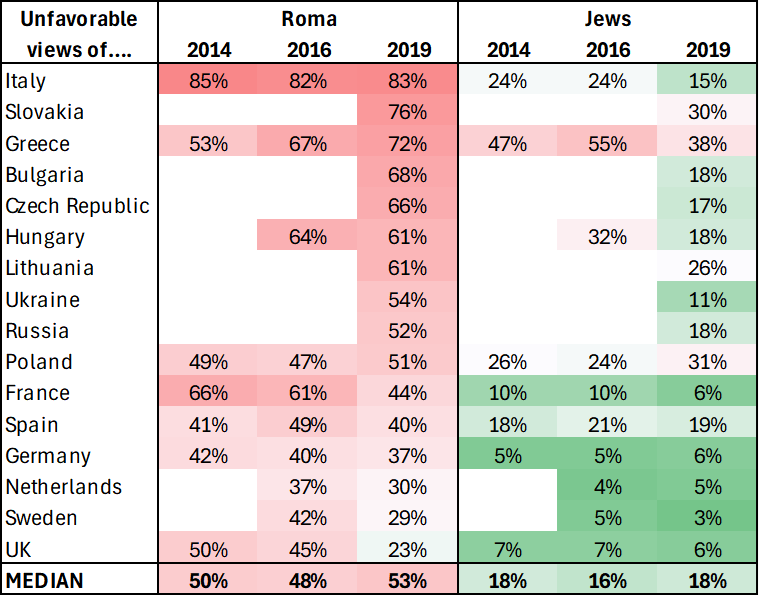
Public attitudes mirror these structural barriers. Anti-Roma prejudice, often termed antiziganism, is deeply rooted across Europe and shapes both policy and everyday interactions. Polling by Pew Research illustrates the severity of this hostility towards Roma people in Europe. Surveys conducted in 2014, 2016 and 2019 shows consistent patterns in European attitudes toward Roma and allow for direct comparison with views of Jews. Across between seven and sixteen countries surveyed, the median results show 48-53% median unfavorability toward Roma and 16-18% median unfavorability toward Jews.
By the most recent 2019 poll, a majority of countries surveyed (10 out of 16) held a net negative view of Roma people, with a median of 53% unfavorable responses. The least negative result was recorded in the UK at 23%, which still represents nearly a quarter of respondents.

By contrast, no country surveyed in 2019 held a net negative view of Jews. The highest level of unfavorability toward Jews was recorded in Greece at 38%, which remains lower than the median unfavorability toward Roma people. This contrast highlights the uniquely severe and widespread nature of anti-Roma sentiment in Europe. These attitudes reinforce stereotypes portraying Roma as criminals or burdens on society, influencing everything from hiring decisions to state policy.
Education systems across Europe also reproduce inequality. A study commissioned by the European Union and Council of Europe under the Inclusive Schools: Making a Difference for Roma Children (INSCHOOL) project found that Roma children are disproportionately placed in “special schools” or classes for students with mild disabilities, even when they do not meet the required criteria. This practice lowers academic expectations and severely limits future opportunities. In some countries, Roma children are concentrated in schools with predominantly Roma student populations that suffer from inadequate funding, poor facilities, and shortages of qualified teachers. Even within mainstream schools, Roma students are frequently streamed into separate or majority-Roma classes. This educational segregation, often closely linked to segregated housing, restricts social mobility and entrenches cycles of exclusion.
Political and institutional failures further deepen these disparities. Anti-Roma sentiment regularly surfaces in mainstream politics, media narratives, and law enforcement practices. Legal protections against discrimination are inconsistently enforced, while top-down policies in some cases actively reinforce segregation or restrict Roma access to housing, education, and public services. These patterns reflect not only the legacy of centuries of persecution, but also Europe’s ongoing failure to confront and dismantle entrenched antiziganism.
Despite these realities, Jews are often portrayed as the uniquely and eternally hated victims of European history, while the ongoing marginalization of Roma people is sidelined. Antiziganism is rarely treated with comparable seriousness, even as antisemitism receives sustained attention across politics, education, media, and popular culture, including major film and entertainment industries.
The figures in this post, checked
Each figure was checked against the source Tariq cited. Open a topic to see the source's own wording for every figure.
| Views of Israel and of religious minorities among non-Jewish publics | 75 |
| Discrimination against Roma and Muslims | 13 |
| Not confirmed: Secondary source only | 5 |
| Not confirmed: No source cited | 3 |